Home
Class 11
PHYSICS
A particle of mass m moving eastward wit...

A particle of mass `m` moving eastward with a speed `v` collides with another particle of the same mass moving northward coalesce on collision. The new particle of mass `2 m` will move in the north - easterly direction with a velocity

A

`v//2`

B

`2v`

C

`v//sqrt2`

D

v

Text Solution

Verified by Experts

The correct Answer is:
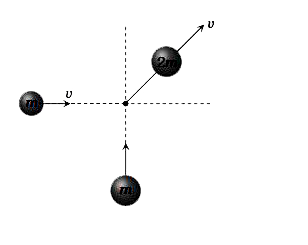
C

`m_1v_1 hati + m_2v_2 hatj =2m .v_3`
`implies mvhati+m_2v_2hatj=2m.v_3`
`implies mvhati+mvhatj =2mv_3`
`implies vsqrt2 =2v_3`
`implies v_3 = v/sqrt2`
Promotional Banner

Similar Questions

Explore conceptually related problems

A particle of mass m moving eastward with a speed v collides with another particle of the same mass moving coalesce on collision. The new particle of mass 2 m will move in the north - easterly direction with a velocity

A particle of mass 10 kg moving eastwards with a speed 5 ms^(-1) collides with another particle of the same mass moving north-wards with the same speed 5 ms^(-1) .The two particles coalesce on collision.The new particle of mass 20 kg will move in the north-east direction with velocity

A particle of mass m moving with speed V collides eleastically with another particle of mass 2mFind speed of smaller mass after head on collision

A particle of mass m moving eastward with a velocity V collides with another particle of same mass moving northwards with the same speed V . The two particles coalesce and the new particle moves in NE direction. Calculate magnitude and direction of velocity of new particle.

A particle of mass m moving towards west with speed v collides with another particle of mass m movies towards south. If two particles st ich t o each other the speed of the new particle of mass 2 m will be

A particle of mass 0.1kg moving with an initial speed v collides with another particle of same mass kept at rest. If after collision total energy becomes 0.2J . Then

A particle of mass m moving with speed u collides perfectly inelastically with another particle of mass 3 m at rest. Loss of KE of system in the collision is

A particle of mass m_1 moves with velocity v_1 and collides with another particle at rest of equal mass. The velocity of the second particle after the elastic collision is

