Home
Class 11
PHYSICS
Particle A of mass mA=m/2 moving along t...

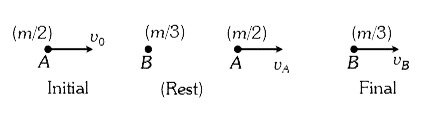
Particle A of mass `m_A=m/2` moving along the x - axis with velocity `v_0` collides elastically with another particle B at rest having mass `m_B=m/3` . If both particles move along the x - axis after the collision , the change `Deltalamda` in de - Broglie wavelength of particle A , in terms of its de - Broglie wavelength `(lamda_0) ` before collision is :

A

`Delta lamda= (3)/(2) lamda_(0)`

B

`Delta lamda= (5)/(2) lamda_(0)`

C

`Delta lamda = 2 lamda_(0)`

D

`Delta lamda= 4 lamda_(0)`

Text Solution

Verified by Experts

The correct Answer is:
D


Applying momentum conservation `(m)/(2) xx v_(0) + (m)/(3) xx (0)= (m)/(2) v_(A) + (m)/(3) v_(B)`
`= (v_(0))/(2) = (v_(A))/(2) + (v_(B))/(3)` ...(i)
Since, collsion is elastic (e=1)
`e=1 = (v_(B)- v_(A))/(v_(0))rArr v_(0)= v_(B)- v_(A)` ...(ii)
on solving eq (i) & (ii): `v_(A)= (v_(0))/(5)`
Now, de-Broglie wavelength of A before collision: `lamda_(0)= (h)/(m_(A) v_(0))= (h)/(((m)/(2))v_(0))`
`rArr lamda_(0)= (2h)/(mv_(0))`
Final De-Broglie wavelength
`lamda_(f)= (h)/(m_(A) v_(0))= (h)/((m)/(2) xx (v_(0))/(5)) rArr lamda_(f)= (10h)/(mv_(0))`
Now, `Delta lamda= lamda_(f)- lamda_(0)`
`Delta lamda= (10h)/(mv_(0))- (2h)/(mv_(0))`
`rArr Delta lamda= (8h)/(mv_(0)) rArr Delta lamda= 4 xx (2h)/(mv_(0))`
`rArr Delta lamda= 4lamda_(0)`
Promotional Banner

Similar Questions

Explore conceptually related problems

A particle of mass m_1 moves with velocity v_1 and collides with another particle at rest of equal mass. The velocity of the second particle after the elastic collision is

A particle of mass m moving with speed V collides eleastically with another particle of mass 2mFind speed of smaller mass after head on collision

A particle of mass m moving with velocity u collides elastically head on with a particle of mass 2m at rest. After collision the heavier particle moves with velocity?

If a ball A of mass m_A = m/2 moving along x-axis collides elastically with ball B of mass m_B = m/3 initially at rest and they move along x-axis. If initially velocity of ball A was v_0 . And initially de-broglie wavelength of ball A is lambda_0 . Find change in debroglie wavelength delta lambda of ball A in terms of lambda_0

A particle of mass m moving with speed u collides perfectly inelastically with another particle of mass 3 m at rest. Loss of KE of system in the collision is

A particle of mass m moving eastward with a speed v collides with another particle of the same mass moving coalesce on collision. The new particle of mass 2 m will move in the north - easterly direction with a velocity

The de-Broglie wavelength of a particle with mass 1 g and velocity 100 m//sec is.

A particle of mass m is moving along the x-axis with initial velocity u i . It collides elastically with a particle of mass 10 m at rest and then moves with half its initial kinetic energy (see figure).If sin theta _(1) = sqrt(n) sin theta_(2) then value of n is

