Home
Class 11
PHYSICS
Two stars of mass m1 and m2 are parts of...

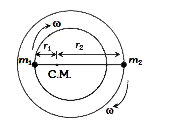
Two stars of mass `m_1` and `m_2` are parts of a binary system. The radii of their orbits are `r_1` and `r_2` respectively, measured from the C.M. of the system. The magnitude of gravitational force `m_1` exerts on `m_2` is

A

`(m_1m_2G)/((r_1+r_2)^2)`

B

`(m_1G)/((r_1+r_2)^2)`

C

`(m_2G)/((r_1+r_2)^2)`

D

`(m_1+m_2)/((r_1+r_2)^2)`

Text Solution

Verified by Experts

The correct Answer is:
A

Both the stars rotate with same angular velocity `omega` around the centre of mass (CM) in their respective orbits as shown in figure.
The magnitude of gravitational force `m_1` exerts on `m_2` is `abs(F)==(Gm_1m_2)/((r_1+r_2)^2)`
Promotional Banner

Similar Questions

Explore conceptually related problems

Two stars of mass m_(1) and m_(2) are parts of a binary star system. The radii of their orbits are r_(1) and r_(2) respectivey, measured from the centre of mass of the system. The magnitude of gravitational force m_(1) exerts on m_(2) is

Two stars of masses m_1 and m_2 form a binary system,revolving around each other in circular orbits of radii r_1 and r_2 respectively.Time period of revolution for this system is

Gravitational force, F=Gm_(1)m_(2)//r.

Two particle of masses m and 2m are at a distance 3r apart at the ends of a straight line AB . C is the centre of mass of the system. The magnitude of the gravitational force on a unit mass placed at C due to the masses is

Two bodies of masses m_(1) and m_(2) are separated by a distance R. The distance of the centre of mass of the bodies from the mass m_(1) is

Two cars of masses m_1 and m_2 are moving in circles of radii r_1 and r_2 , respectively. Their speeds are such that they make complete circles in the same time t. The ratio of their centripetal acceleration is

Two stars of masses m_(1) and m_(2) distance r apart, revolve about their centre of mass. The period of revolution is :

Two satellites of masses 3 m and m orbit the earth in circular orbits of radii r and 3 r respectively. The ratio of the their speeds is

A planet of mass M, has two natural satellites with masses m1 and m2. The radii of their circular orbits are R_(1) and R_(2) respectively. Ignore the gravitational force between the satellites. Define v_(1), L_(1), K_(1) and T_(1) to be, respectively, the orbital speed, angular momentum, kinetic energy and time period of revolution of satellite 1 , and v_(2), L_(2), K_(2) and T_(2) to be he corresponding quantities of satellite 2. Given m_(1)//m_(2) = 2 and R_(1)//R_(2) = 1//4 , match the ratios in List-I to the numbers in List-II.

