Home
Class 11
PHYSICS
Two spherical soap bubbles of radii r1 a...

Two spherical soap bubbles of radii `r_1` and `r_2` in vacuume collapse under isothermal condition. The resulting bubble has radius `R` such that

A

`sqrt(r_1r_2)`

B

`sqrt(r_1^2+r_2^2)`

C

`(r_1r_2)/(r_1+r_2)`

D

`(r_1+r_2)/(2)`

Text Solution

Verified by Experts

The correct Answer is:
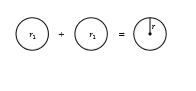
B

`P_0=0`

`P_1=P_0+(4T)/(r_1),P_2=P_0+(4T)/r_2,P=P_0+(4T)/r`
And `n_1+n_2=n`
`implies (P_1V_1)/(RT)=(P_2V_2)/(RT)=(PxxV)/(RT)`
`implies r_1^2+r_2^2=r^2`
`implies r= sqrt(r_1^2+r_2^2)`
Promotional Banner

Similar Questions

Explore conceptually related problems

Two spherical soap bubbles of radii a and b in vacuum coalesce under isothermal conditions. The resulting bubble has a radius given by

Two spherical soap bubbles of a radii 1 cm and 2 cm vacuum coalesce under isothermal conditions . The resultant bubble has a radius of

Two soap bubbles having radii 3 cm and 4 cm in vacuum, coalesce under isothermal conditions. The radius of the new bubble is

Two soap bubbles, each of radius r, coaleses in vacuum under isotermal conditions to from a bigger bubble of radius R. Then R is equal to

Two soap bubbles of radii 2 cm and 5 cm coalesce under isothermal condition in vaccum, to form a bigger bubble. Find the radius of new bubble.

A soap bubble of radius 6 cm and another bubble of 8 cm coalesce under isothermal xonditions in vacuum. The radius of the new bubble is

Two soap bubble of radii r_(1) and r_(2) combime to form a single bubble of radius r under isothermal conditions . If the external pressure is P, prove that surface tension of soap solution is given by S=(P(r^(3)-r_(1)^(3)-r_(2)^(3)))/(4(r_(1)^(2)+r_(2)^(2)-r^(2))) .

Two soap bubbles of radii 1 mm and 2 mm merge isothermally . Then radius of the new bubble formed would be

If a soap bubble of radius 3 cm coalesce with another soap bubble of radius 4 cm under isothermal conditions the radius of the redultant bubble formed is in cm

