Home
Class 11
PHYSICS
A system goes from A and B via two proce...

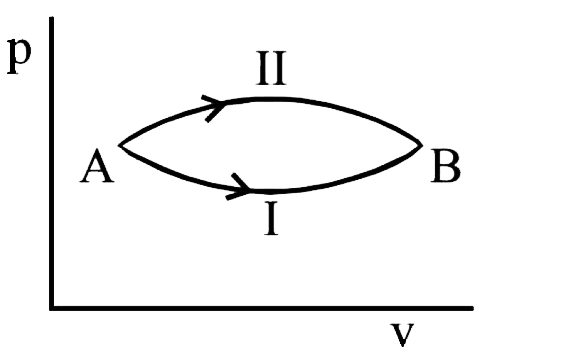
A system goes from A and B via two processes. I and II as shown in figure. If `DeltaU_1 and DeltaU_2` are the changes in internal energies in the processes I and II respectively, then

A

`DeltaU_(II) gt DeltaU_(I)`

B

`DeltaU_(II) lt DeltaU_(I)`

C

`DeltaU_(I) = DeltaU_(II)`

D

Relation between `DeltaU_I and DeltaU_(II)` can not be determined

Text Solution

Verified by Experts

The correct Answer is:

C

Since, internal energy is point function
Hence, `DeltaU_(I) = DeltaU_(II)`
Promotional Banner

Similar Questions

Explore conceptually related problems

A system goes from A and B via two processes. I and II as shown in figure. If DeltaU_1 and DeltaU_2 are the changes in internal enregies in the processes I and II respectively, then

A system goes from A to B via two processes I and II as shown in the figure. If DeltaU_(1) and DeltaU_(2) are the changes in the internal energies in the processes I and II respectively, then -

A system goes from state A to B via two processes I and II, as shown in Fig. 12.25, How are delta mu_1 and delta mu_2 (the changes in internal energies in the processes I and II) related to each other ?

Refer to let DeltaU_(1) and DeltaU_(2) be the changes in internal energy of the system in the processes A and B. then

Two path 1 and 2 are shown in figure. If the change in internal energies are U_1 , and U_2 for path 1 and 2 respectively, then

An ideal gas goes from State A to state B via three different process as indicate in the P-V diagram. If Q_(2), Q_(3) indicates the heat absorbed by the gas along the three processes and DeltaU_(1), DeltaU_(2), DeltaU_(3) indicates the change in internal energy along the three processes respectively, then

shows two processes A and B on a system.Let DeltaQ_(1) and DeltaQ_(2) be the heat given to the system in processes A and B respectively. Then

What will be nature of change in internal energy in case of processes shown below ?

Observe the given figure and identify the process (I) and (II)
