Home
Class 11
PHYSICS
Two masses m1 and m2 are suspended toget...

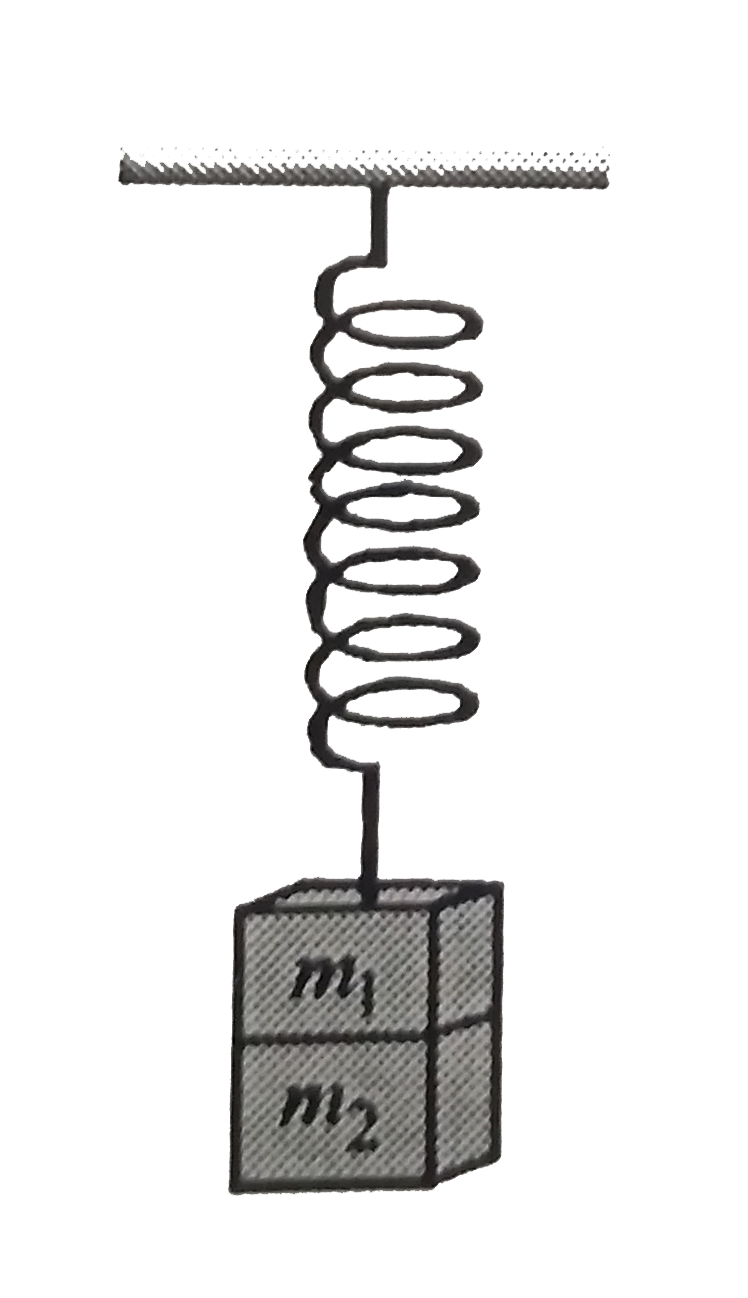
Two masses m1 and m2 are suspended together by a massless spring of constant k. When the masses are in equilibrium, m1 is removed without disturbing the system. The amplitude of oscillations is

A

`(m_(1)g)/(K)`

B

`(m_(2)g)/(K)`

C

`((m_(1)+m_(2))g)/(K)`

D

`((m_(1)-m_(2))g)/(K)`

Text Solution

Verified by Experts

The correct Answer is:

A

`m_(2)g=kl` . . . (i)
l is the extension in the string when only `m_(2)` is connected.
Now, `(m_(1)+m_(2))g=k(l+Deltal)` . . . (ii)
`Deltal to ` increase in extension when `(m_(1)+m_(2))` is connected
from equation (i) and (ii)
`m_(1)g=k Deltal implies Deltal=(m_(1)g)/(k)`.
Promotional Banner

Similar Questions

Explore conceptually related problems

Two masses m 1 and m 2 are suspended together by a massless spring of constant K . When the masses are in equilibrium, m 1 is removed without disturbing the system. The amplitude of oscillations is

Two masses M and m are suspended together by massless spring of force constant -k. When the masses are in equilibrium, M is removed without disturbing the system. The amplitude of oscillations.

Two masses m_(1) and m_(2) are suspended together by a massless spring of constant K. When the masses are in equilibrium, m_(1) is removed without disturbing the system. Then the angular frequency of oscillation of m_(2) is -

Two masses 8 kg 4 kg are suspended together by a massless spring of spring constant 1000 Nm^(-1) . When the masses are in equilibrium 8 kg is removed without disturbing the system . The amplitude of oscillation is

Two masses m_(1) = 1kg and m_(2) = 0.5 kg are suspended together by a massless spring of spring constant 12.5 Nm^(-1) . When masses are in equilibrium m_(1) is removed without disturbing the system. New amplitude of oscillation will be

Two mass m_(1) and m_(2) are suspended from a massless spring of force constant k. When the masses are in equilibrium, m_(1) is removed without disturbing the system. Find the angular frequency and amplitude of oscillations.

Two masses m_(1) and m_(2) are suspeded togther by a massless spring of spring constnat k (Fig). When the masses are in equilibrium, m_(1) is removed. Frequency and amplitude of oscillation of m_(2) are

Two masses m_(1) and m_(2) are suspended from a spring of spring constant 'k'. When the masses are in equilibrium, m_(1) is gently removed. The angular frequency and amplitude of oscillation of m_(2) will be respectively

Two masses m_(1)=1.0 kg and m_(2)=0.5 kg are suspended together by a massless spring of force constant, k=12.5 Nm^(-1) . When they are in equillibrium position, m_(1) is gently removed. Calculate the angular frequency and the amplitude of oscillation of m_(2) . Given g=10 ms^(-2) .
