Home
Class 11
PHYSICS
A small block is connected to one end of...

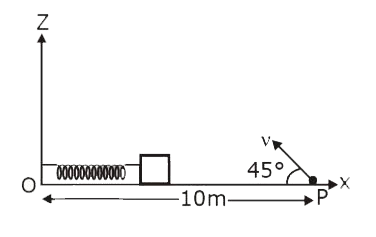
A small block is connected to one end of a massless spring of un-stretched length 4.9 m. The other end of the spring (see the figure) is fixed. The system lies on a horizontal frictionless surface. The block is stretched by 0.2 m and released from rest at t = 0. It then executes simple harmonic motion with angular frequency `omega = (pi)/(3) `rad/s . Simultaneously at t = 0, a small pebble is projected with speed `nu` from point P at an angle of `45^(@)` as shown in the figure. Point P is at a horizontal distance of 10 m from O. If the pebble hits the block at t = 1s, the value of `nu` is (take g = 10 m/`s^(2)` )

A

` sqrt(50) m//s`

B

`sqrt(51) m//s`

C

`sqrt(52) m//s`

D

`sqrt(53) m //s`

Text Solution

Verified by Experts

The correct Answer is:

A

Time of flight for projectile
`T = (2 u sin 45^(@))/( g) ` = 1 sec
`rArr (2 u sin 45^(@))/( g) ` = 1 sec
`u = (g)/( sqrt( 2)) rArr u = sqrt(50) m//s `
Promotional Banner

Similar Questions

Explore conceptually related problems

A 100 g block is connected to a horizontal massless spring of force constant 25.6(N)/(m) As shown in Fig. the block is free to oscillate on a horizontal frictionless surface. The block is displaced 3 cm from the equilibrium position and , at t=0 , it is released from rest at x=0 It executes simple harmonic motion with the postive x-direction indecated in Fig. The position time (x-t) graph of motion of the block is as shown in Fig. Q. When the block is at position B on the graph its.

A 100 g block is connected to a horizontal massless spring of force constant 25.6(N)/(m) As shown in Fig. the block is free to oscillate on a horizontal frictionless surface. The block is displaced 3 cm from the equilibrium position and , at t=0 , it is released from rest at x=0 It executes simple harmonic motion with the postive x-direction indecated in Fig. The position time (x-t) graph of motion of the block is as shown in Fig. Q. When the block is at position A on the graph, its

A 100 g block is connected to a horizontal massless spring of force constant 25.6(N)/(m) As shown in Fig. the block is free to oscillate on a horizontal frictionless surface. The block is displaced 3 cm from the equilibrium position and , at t=0 , it is released from rest at x=0 It executes simple harmonic motion with the postive x-direction indecated in Fig. The position time (x-t) graph of motion of the block is as shown in Fig. When the block is at position C on the graph, its

A 100 g block is connected to a horizontal massless spring of force constant 25.6(N)/(m) As shown in Fig. the block is free to oscillate on a horizontal frictionless surface. The block is displaced 3 cm from the equilibrium position and , at t=0 , it is released from rest at x=0 It executes simple harmonic motion with the postive x-direction indecated in Fig. The position time (x-t) graph of motion of the block is as shown in Fig. Position of the block as a function of time can now be expressed as

A 100 g block is connected to a horizontal massless spring of force constant 25.6(N)/(m) As shown in Fig. the block is free to oscillate on a horizontal frictionless surface. The block is displaced 3 cm from the equilibrium position and , at t=0 , it is released from rest at x=0 It executes simple harmonic motion with the postive x-direction indecated in Fig. The position time (x-t) graph of motion of the block is as shown in Fig. Velocity of the block as a function of time can be expressed as

Two blocks of mass 2kg and 5kg are given speed as shown in the figure. System is lying on a frictionless surface and the blocks are connected by a massless spring if spring constant 35 N/m . Find the maximum compression in the spring.

A block of mass m is attached to one end of a mass less spring of spring constant k. the other end of spring is fixed to a wall the block can move on a horizontal rough surface. The coefficient of friction between the block and the surface is mu then the compession of the spring for which maximum extension of the spring becomes half of maximum compression is .

A particle of mass m is fixed to one end of a massless spring of spring constant k and natural length l_(0) . The system is rotated about the other end of the spring with an angular velocity omega ub gravity-free space. The final length of spring is
