Home
Class 11
PHYSICS
The mass M shown in the figure oscillate...

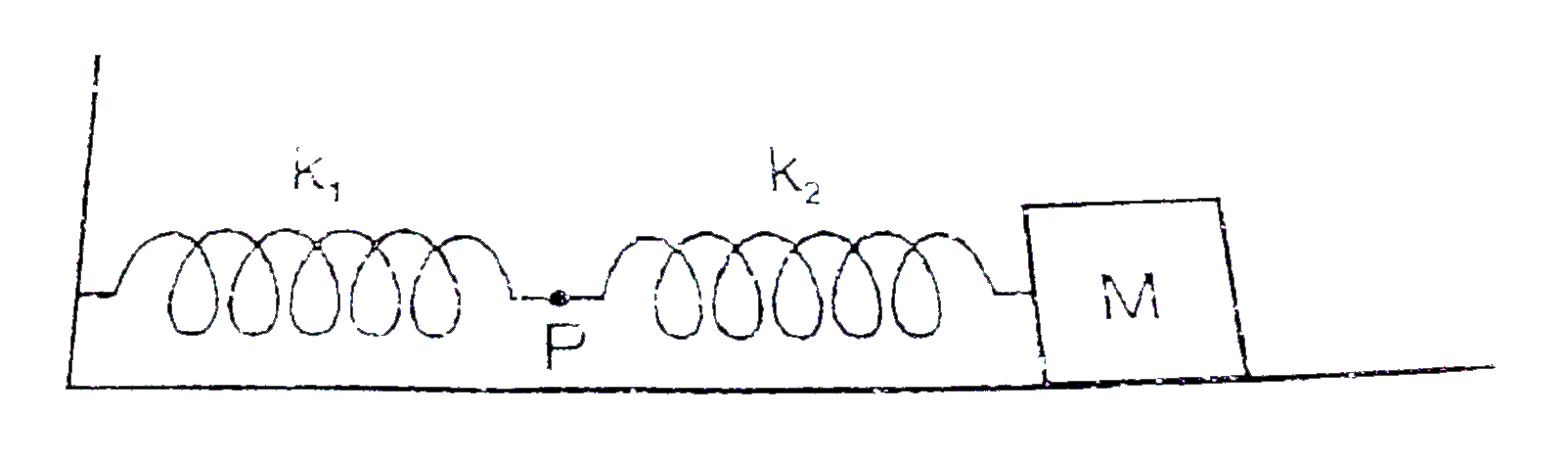
The mass `M` shown in the figure oscillates in simple harmnonic motion and amplitude `A`. The amplitude of the point `P` is

A

`(k_(1)A)/(k_(2))`

B

`(k_(2)A)/(k_(1))`

C

`(k_(1) A)/( k_(1) + k_(2))`

D

`(k_(2) A)/( k_(1) + k_(2))`

Text Solution

Verified by Experts

The correct Answer is:

D

Let extensions in spring are ` x_(1) and x_(2)`
` k_(1) x_(1) = k_(2) x_(2) and x_(1) + x_(2) = A `
`x_(2) = (k_(1) x_(1))/( k_(2)) rArr x_(1) + (k_(1) x_(1))/( k_(2)) = A `
`rArr x_(1) = (k_(2) A)/( k_(1) + k_(2))`
Promotional Banner

Similar Questions

Explore conceptually related problems

The mass M shown in figure ocillates in simple harmonic motion with amplitude A. The amplitude of the point P is

The mass M shown in the figure oscillates in simple harmonic motion with amplitude A. The maximum speed of junction P is V_0 . Assume springs are massless. Select the correct option/s

The figure shows a mass M attached to a series arrangement of two springs of spring constants k_(1) and k_(2) where k_(2) = 2k_(1) . If the mass M oscillates in simple harmonic motion with amplitude A, the amplitude of the point O is (alphaA)/(beta) . Find beta-alpha .

The total work done by the restoring force in simple harmonic motion of amplitude A and angular velocity omega in one oscillation is

A particle executes simple harmonic motion of amplitude A. At what points is its speed half the maximum speed ?

A simple harmonic motion is represented by F(t)=10sin(20t+0.5) . The amplitude of the S.H.M. is

The maximum velocity a particle, executing simple harmonic motion with an amplitude 7 mm, 4.4 m//s. The period of oscillation is.

A mass m oscillates with simple harmonic motion with frequency f = (omega)/(2 pi) and amplitude A on a spring of stiffness constant K. Which of the following is not correct ?

A mass M is attached to a horizontal spring of force constant k fixed one side to a rigid support as shown in figure. The mass oscillates on a frictionless surface with time period T and amplitude A. When the mass M is in equilibrium position, another mass m is gently placed on it. When will be the new amplitude of ocillation?

The total work done by a restoring force in simple harmonic motion of amplitude A and angular velocity. omega , in one oscillation is
