Home
Class 11
PHYSICS
In the given figure, a mass M is attache...

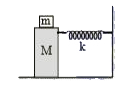
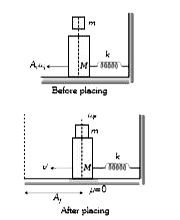
In the given figure, a mass M is attached to a horizontal spring which is fixed on one side to a rigid support. The spring constant of the spring is k. The mass oscillates on a frictionless surface with time period T and amplitude A. When the mass is in equilibrium position, as shown in the figure, another mass m is gently fixed upon it. The new amplitude of oscillation will be :

A

` A sqrt((M + m)/(M))`

B

` A sqrt((M - m)/(M))`

C

` A sqrt((M )/(M+m))`

D

` A sqrt((M )/(M-m))`

Text Solution

Verified by Experts

The correct Answer is:
C


We know that ` omega sqrt((k)/( M - m)) and omega _(1) = sqrt(( k)/(M)) (A_(i) = A)`
Also, momentum is conserved just befor and just after the block of mass (m) is placed because there is no impulsive force . So,
`MA_(i) omega _(i) = (M + m) v.`
`v. = (M A_(f) omega _(f))/((M + m)) , v. = A_(f) omega _(f)`
`(MA omega_(i))/( (M + m)) = A_(f) sqrt((k)/( (M + m)))`
`rArr (Ma sqrt((k)/(M)))/(M + m) xx sqrt((M + m)/( k)) = A_(f)`
`rArr A_(f) = A sqrt((M)/((M + m)))`
Aliter : On putting m on M. Let velocity becomes B `(m + M) V = MV_(0)` (by momentum conservation)
Now, kinetic Energy ` = (1)/(2) (m + M) V^(2)`
`K. = (1)/(2) (m + M) (M^(2) V_(0)^(2))/((m + M) ^(2))`
`K. = (1)/(2) (M^(2) V_(0)^(2))/( (M + m))` [` :. (1)/(2) MV_(0) ^(2) = (1)/(2) kA^(2) and K. = (1)/(2) k (A.)^(2)` ]
Hence `A. = sqrt((M)/( (M + m))) A `
Promotional Banner

Similar Questions

Explore conceptually related problems

A mass M is attached to a horizontal spring of force constant k fixed one side to a rigid support as shown in figure. The mass oscillates on a frictionless surface with time period T and amplitude A. When the mass M is in equilibrium position, another mass m is gently placed on it. When will be the new amplitude of ocillation?

Block of mass m_(2) is in equilibrium as shown in figure. Anotherblock of mass m_(1) is kept gently on m_(2) . Find the time period of oscillation and amplitude.

An object of mass M oscillating with amplitude 'A' mass 'm' is added at mean position. Find new amplitude of oscillation.

A body of mass m is suspended from three springs as shown in figure. If mass m is displaced slightly then time period of oscillation is

A load of mass M is attached to the bottom of a spring of mass 'M //3' and spring constant 'K'. If the system is set into oscillation, the time period of oscillation is

Two identical springs of spring constant '2k' are attached to a block of mass m and to fixed support (see figure).When the mass is displaced from equilibrium position on either side, it executes simple harmonic motion. The time period of oscillations of this sytem is :

A particle of mass m is attached to three identical springs of spring constant k as shwon in figure. The time period of vertical oscillation of the particle is

Two identical springs of spring constant k are attached to a block of mass m and to fixed supports as shwon in figure . Show that when the mass is displaced from its equilibrium position on either side, it executes a simple harmonic motion. Find th eperiod of oscillation.

Two masses m1 and m2 are suspended together by a massless spring of constant k. When the masses are in equilibrium, m1 is removed without disturbing the system. The amplitude of oscillations is

When a mass M is attached to the spring of force constant k , then the spring stretches by . If the mass oscillates with amplitude l , what will be maximum potential energy stored in the spring

