Home
Class 12
PHYSICS
Charges 4Q, q and Q and placed along x-a...

Charges 4Q, q and Q and placed along x-axis at positions `x=0,x=1//2` and `x=1`, respectively. Find the value of q so that force on charge Q is zero

A

x = 0.775m

B

x = 1.2m

C

x = 0.5m

D

Position depends on the amount of charge

Text Solution

Verified by Experts

The correct Answer is:
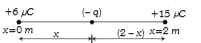
A


`F_1 = F_2`
`implies (K xx6 xxqxx10^(-6))/x^2 = (Kxx15 xx10^(-6)xxq)/((2-x)^2)`
`implies (2-x)/x=sqrt(15/6)=1.58 implies 2 - x = 1.58x`
`implies x =2/(2.58) = 0.775m`
Promotional Banner

Similar Questions

Explore conceptually related problems

Charges 4Q, q and Q and placed along x-axis at positions x=0,x=t//2 and x=1 , respectively. Find the value of q so that force on charge Q is zero

Point charges +4q, -q are kept on the x -axis at points x=0,x=a and X=2a respectively, then

Three charges 4q, Q and q are in a straight line in the position of 0. l//2 and l respectively. The resultant force on q will be zero, if Q=

Point charges q_1 and q_2 lie o the x-axis at points x=-a and x=+a respectively. a. How must q_1 and q_2 be related for the net electrostatic force on point charge +Q , placed at x=+a/2, to be zero? b. With the same point charge +Q now placed ate x=+3a//2

Charges Q-q, Q,-q are placed at the corners A, B, C,D of a square respectively. If the resultant force on the charge Q is zero due to other charges, what is the relation between Q and q ?

(a) Two point charges Q and 16 Q are fixed at separation d . Where should a third point charge be placed between them so that it experiences no force I.e. in equilibrium ? (b) In the previous problem , if we replace Q by - Q , where should the third charge be placed on the joining the charges so that it is equilibrium ? (c ) Three point charges Q , q and Q are placed at x = 0 , x = d//2 and x = d . Find q in terms of Q so that all charges are in equilibrium. (d) Two point charges 9 Q and 25 Q are placed at separation d . Where should a third charge q be placed between them so that all charges are in equilibrium ? Also find the value of q and its nature.

A two point charges 4q and -q are fixed on the x - axis x=-d/2 and x = d/2 , respectively. If a third point charge 'q' is taken from the origin to x = d along the semicircle as shown in the figure, the energy of the charge will

