Home
Class 12
PHYSICS
Two identical balls having like charges ...

Two identical balls having like charges and placed at a certain distance apart repel each other with a certain force. They are brought in contact and then moved apart to a distance equal to half their initial separation. The force of repulsion between them increases 4.5 times in comparision with the initial value. The ratio of the initial charges of the balls is

A

2

B

3

C

4

D

6

Text Solution

Verified by Experts

The correct Answer is:
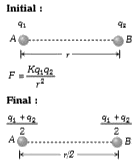
A


`F.=(K(q_1+q_2)^2)/r^2`
Now F. = 4.5 F
`=(K(q_1+q_2)^2)/r^2=4.5 (Kq_1q_2)/r^2`
`implies(q_1+q_2)^2=4.5 q_1q_2`
`implies q_1^2 +q_2^2 =2q_1q_2 = 4.5 q_1q_2`
`implies q_1^2 +q_2^2 -2.5 q_1q_2=0`
`= (q_1/q_2)^2+1-2.5 (q_1)/q_2=0`
`q_1/q_2 = (+2.5 pmsqrt(6.25 -4))/2`
`=(2.5 pm 1.5)/2= 2,(1)/2`
Promotional Banner

Similar Questions

Explore conceptually related problems

Two charged balls attract each other with a certain force. If they are allowed to touch and then get separated to the same distance apart, the balls will:

If two identical spheres having charge 16 mu C and -8 mu C are kept at certain distance apart , then the force if F. They are touched and again kept at the same distance , the force becomes.

If two identical spheres having charge 16muC and -8mu C are kept at certain distance apart, then the force is F. They are touched and again kept at the same distance, the force becomes

Two charges are placed at a distance apart if a glas slab is placed between them force between them will

Two chargeed metallic spheres of same size repel each other by a force F. They are now touched with each other and are then separated to same initial distance. Now the force of repulsion is F'. Which of the following are possible?

Two current elements are placed a certain distance apart but not parallel to each other. Do they exert equal and opposite forces on each other?

Two points charges q_1 and q_2 are placed at a distance of 50 m from each each other in air, and interact with a certain force. The same charges are now put in oil whose relative permittivity is 5. If the interacting force between them is still the same, their separation now is

