Home
Class 12
PHYSICS
A positively charged rod lies along X-ax...

A positively charged rod lies along X-axis in such a manner that one end of the rod is at the origin and the other end at `x =-oo`. The linear charge density for the rod is `lambda`. Electric field intensity at x =a is

A

`vecE=lamda/(4piepsilon_0a)(-hati)`

B

`vecE=lamda/(4piepsilon_0a)(-hati)`

C

`vecE=lamda/(2piepsilon_0a)(-hati)`

D

`vecE=lamda/(2epiepsilon_0a)(-hati)`

Text Solution

Verified by Experts

The correct Answer is:
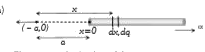
A


Charge on dx is `dq = lamdadx`
Electric field due to element dx
`dE= (dq)/(4piepsilon_0x^2)implies E=int_a^(oo)(lamdadx)/(4piepsilon_0x^2)`
`implies E= (lamda)/(4piepsilon_0)[(x^(-2+1))/(-2+1)]_a^(oo) =(lamda)/(4piepsilon_0a)implies vecE =(lamda)/(4piepsilon_0a)(-hati)`
Promotional Banner

Similar Questions

Explore conceptually related problems

Calculate the potential due to a thin uniformly charged rod of length L at the poiot P shown in figure. The lioear charge density of the rod is lambda C//m

A non-uniform thin rod of length L is palced along X-axis so that one of its ends is at the origin. The linear mass density of rod is lambda = lambda_(0)x . The centre of mass of rod divides the length of the rod in the ratio:

A semi-infinite insulating rod has linear charge density lambda . The electric field atthe pointPshown in figure-1.418 is:

Three rods each of length L and mass M are placed along X, Y and Z axis in such a way that one end of each of the rod is at the origin. The moment of inertia of this system about Z axis is

Calculate the potential due to a thin charged rod of length L at the points along and perpendicular to the length. Charge per unit length on the rod is lambda .

A non–uniform thin rod of length L is placed along x-axis as such its one of ends at the origin. The linear mass density of rod is lambda=lambda_(0)x . The distance of centre of mass of rod from the origin is :

A rod of length L is placed along the x-axis between x=0 and x=L. The linear mass density is lambda such that lambda=a+bx . Find the mass of the rod.

