Home
Class 12
PHYSICS
An electron is released from the bottom ...

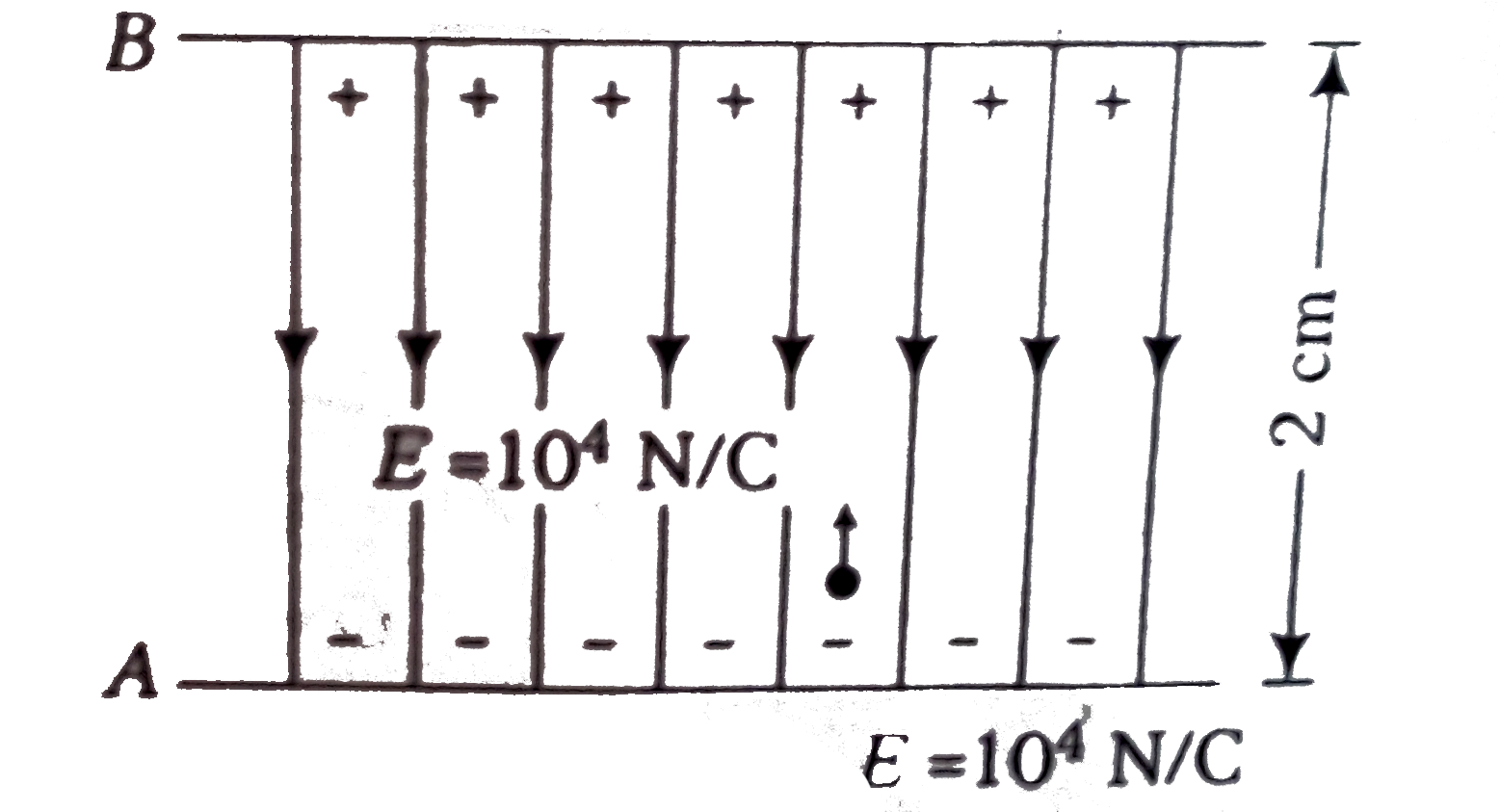
An electron is released from the bottom plate A as shown in the figure `(E = 10^(4) N//C)`. The velocity of the electron when it reaches plate B will be nearly equal to

A

`0.85 xx10^7 m//s`

B

`1.0 xx10^7 m//s`

C

`1.25 xx10^7 m//s`

D

`1.65 xx10^7 m//s`

Text Solution

Verified by Experts

The correct Answer is:

A

`F=eE implies ma = eE implies a = (eE)/(m) , S = 2cm " & " u =0 `
`v^2=u^2+2aS implies v=sqrt(2aS) = sqrt(2xx(eE)/m xx2 xx10^(-2))`
`=sqrt((2 xx1.6 xx10^(-19) xx10^4xx2 xx10^(-2))/(9xx10^(-31)))`
`=0.843 xx10^7 m//s ~~ 0.85 xx10^7 m//s`
Promotional Banner

Similar Questions

Explore conceptually related problems

A block of A is released from rest from the top of wedge block of height h shown in figure-4.55. If velocity of block when it reaches the bottom of inclive is v_(0) , find the time os sliding.

An electron is released from rest in a uniform electric field of magnitude 2.00 xx 10^(4) N//C . (a) Calculate the acceleration of the electron. (Ignore gravitational) (b) How much time does the electron take to reach 1.00 % of the speed of light ?

A uniform magnetic field (B) is applied between the plates of a capacitor in the outward direction as shown in the figure. Surface charge density on the capacitor plates is sigma . An electron is fired in between the plates, parallel to them, as shown in the figure. The electron is found to move straight in-between the plates of capacitor. Neglect the gravity. If L is the length of the plates then caleulate the time taken by the electron to cross the plates.

The wavelength of an electron , moving with the velocity 3 xx 10^(3) m/s , is nearly equal to

Two charged metal plates in vacuum are 10cm apart. A uniform electric field of intensity (45//16)xx10^(3)NC^(-1) is applied between the plates. An electron is released between the plates from rest at a point just outside the negative plate. (a) Calculate how long (t) will the electron take to reach the other plate? (b) At what velocity (v) will it be electron take to hits teh other plate?

In the uniform electric field of E = 1 xx 10^(4) N C^(-1) , an electron is accelerated from rest. The velocity of the electron when it has travelled a distance of 2 xx 10^(-2) m is nearly ( (e)/(m) of electron = 1.8 xx 10^(11) C kg^(-1) )

The potential difference between two large parallel plates is varied as v = at, a is a positive constant and t is time. An electron starts from rest at t=0 from the plate which is at lower potential. If the distance between the plates is L, mass of electron m and charge on electron -e then find the velocity of the electron when it reaches the other plate.

An electron enters the region between the plates of a parallel plate capacitor at a point equidistance from either plate. The capacitor plates are 2 xx 10^(-2)m apart and 10^(-1)m long. A potential difference of 300 V is kept across the plates. Assuming that the initial velocity of the electron is parallel to the capacitor plates, calculate the largest value of the velocity of the electrons so that they do not fly out of the capacitor at the other end.

At some instant the velocity components of an electron moving between two charged parallel plates are v_x=1.5xx10^5m//s and v_y=3.0xx10^6 m//s .Suppose that the electric field between the plates is given by E = (120 N//C) hatj . (a) What is the acceleration of the electron? (b) What will be the velocity of the electron after its x-coordinate has changed by 2.0 cm?
