Home
Class 12
PHYSICS
Three identical dipoles are arranged as ...

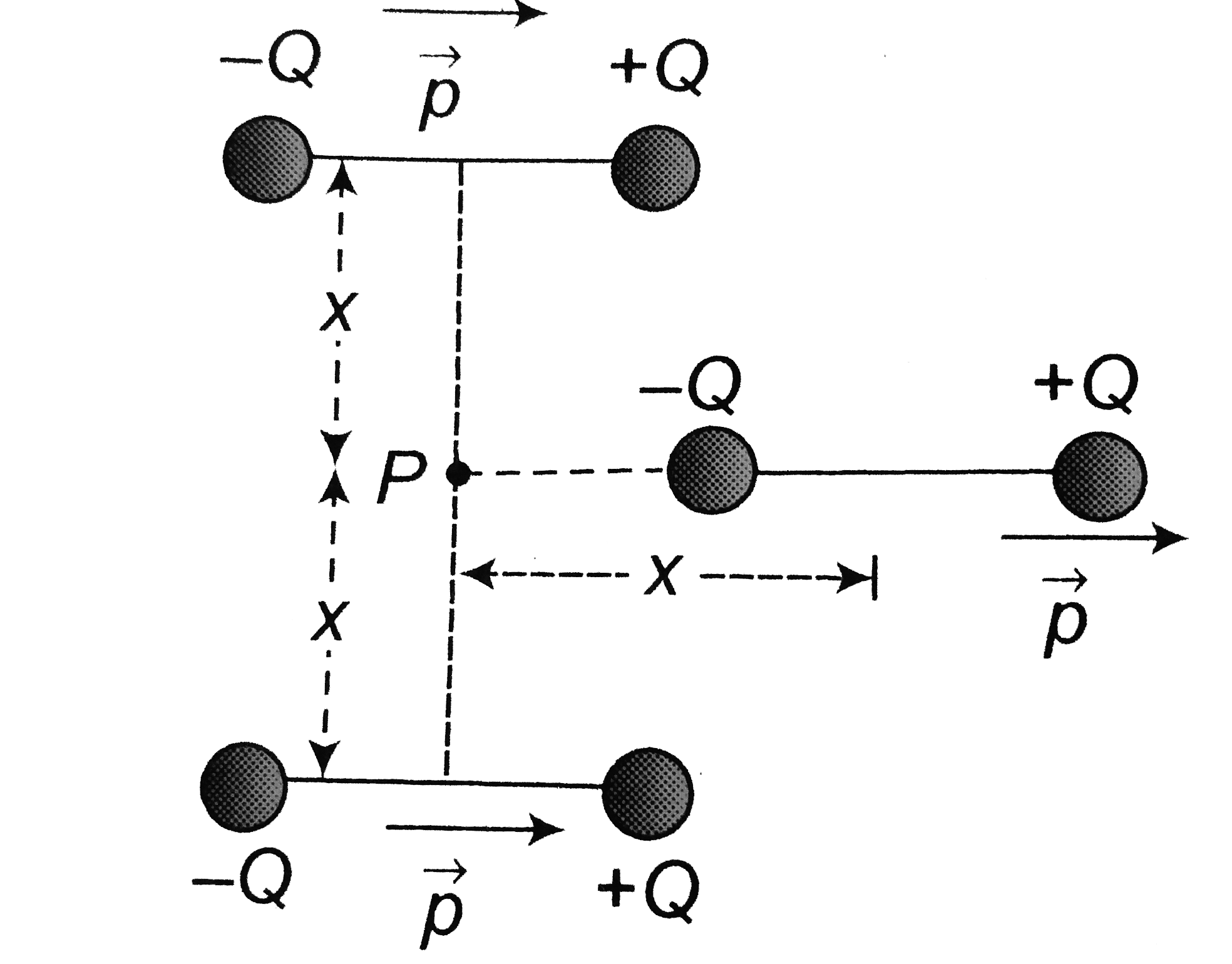
Three identical dipoles are arranged as shown below. What will be the net electric field at `P`? `(k=1/(4pi epsilon_(0)))`

A

`(K.p)/(x^3)`

B

`(2Kp)/(x^3)`

C

Zero

D

`(sqrt2Kp)/(x^3)`

Text Solution

Verified by Experts

The correct Answer is:
C

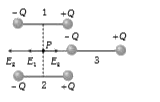
`E_1=(Kp)/x^3(-hati)`
`E_2=(Kp)/(x^3)(-hati)`
`E_3=(2Kp)/(x^3)(hati)`
`E_1+E_2+E_3=0`
Promotional Banner

Similar Questions

Explore conceptually related problems

The correct formula for potential energy in the electric field of an electrical dipole body is, when the angle of the electric dipole is theta with the electric field (k=(1)/( 4pi in_(0)))

Four charges are arranged on y axis as shown in figure. Then the electric field at point P is proportional to:

Three charges +q, +q, +2q are arranged as shown in figure. What is the field at point P (center of side AC)

If the elctron ( charge of each electron =-e) are shifted by a small distance x,a net + ve charge density ( per unit area ) is induced on the surface. This will result in an electric field E=n ex //epsilon_(0) in the direction of x and a restoring force on an electron of -(n e^(2)x)/(epsilon_(0)) , Thus m ddot(x) =-(n e^(2)x)/(epsilon_(0)) or ddot(x) + ( n e^(2))/( m epsilon_(0))x=0 This gives omega_(p)= sqrt((n e^(2))/( m epsilon_(0)))=1.645xx10^(16)s^(-1) as the plasma frequency for the problem,.

Three large parallel plates have unifrom surface charge densities as shown in the figure. What is the electric field at P .

what is the net force on a dipole in a uniform electric field ?

Two point electric dipoles with dipole moment P_(1) and P_(2) are separated by a distance r with their dipole axes mutually perpendicular as shown. The force of interaction between the dipoles is (where k=(1)/(4piepsilon_(0)) )

A dipole is placed at origin of corrdinate system as shown in figure, find the electric field at point P (0, y) .

Four electrical charge are arranged on the corners of a 10cm square as shown. What would be the direction of the resulting electric field of the resulting electric field at the center point P?

