Home
Class 12
PHYSICS
Electric charge is uniformly distributed...

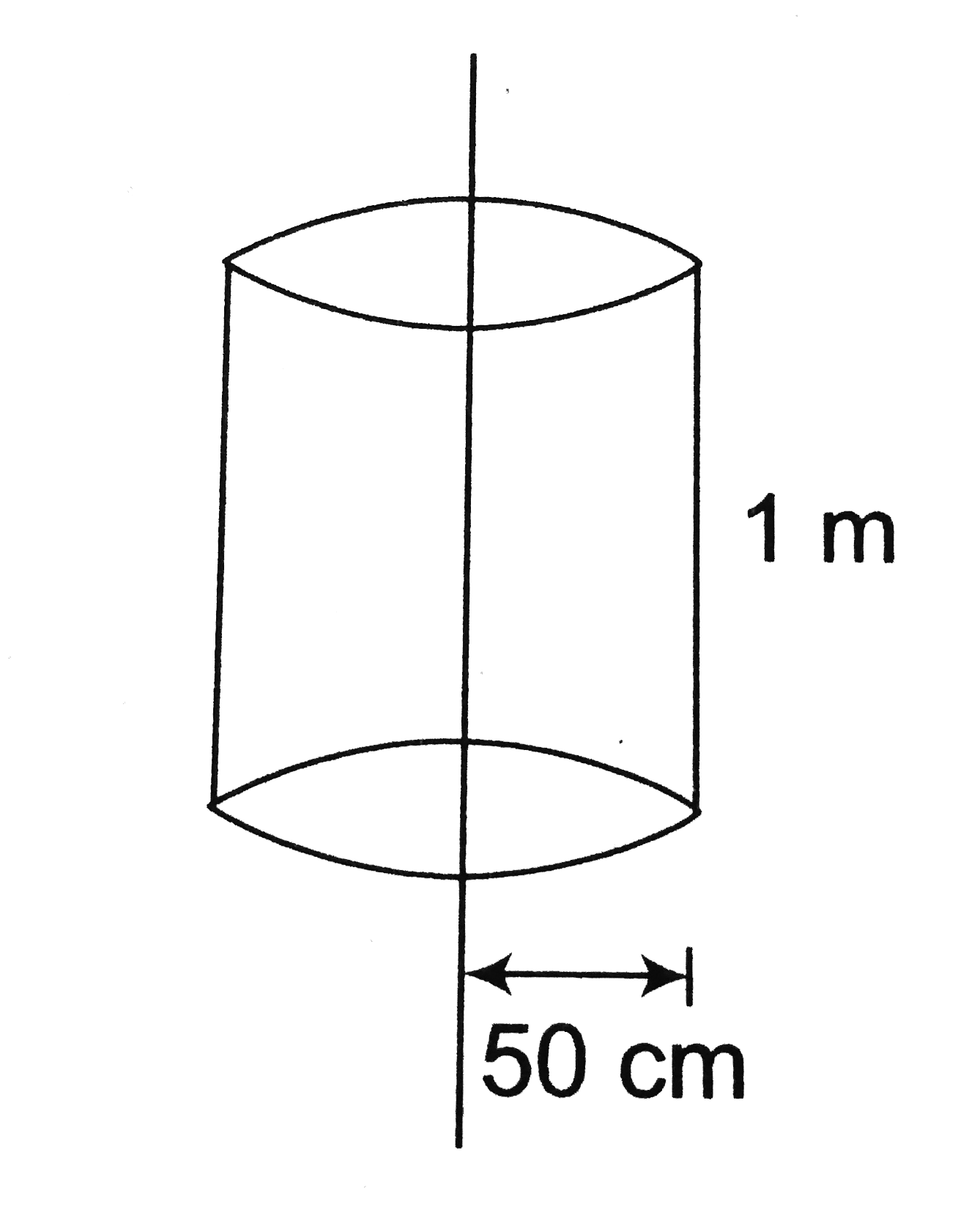
Electric charge is uniformly distributed along a along straight wire of radius `1 mm`. The charge per centimeter length of the wire is `Q` coulomb. Another cyclindrical surface of radius `50 cm` and length `1 m` symmetrically enclose the wire ask shown in figure. The total electric flux passing through the cyclindrical surface is

A

`Q/(epsilon_0)`

B

`(100Q)/(epsilon_0)`

C

`(10Q)/((pi epsilon_0))`

D

`(100Q)/((piepsilon_0))`

Text Solution

Verified by Experts

The correct Answer is:

B

Total charge = 100Q ( Q charge per cm `:. 1 cm rarrQ , :. 1m rarr 100 cm rarr 100Q)`
`phi = (100Q)/(epsilon_0)`
Promotional Banner

Similar Questions

Explore conceptually related problems

Electric charge is uniformly distributed along a long straight wire of radius 1 mm. The charge per cm length of the wire Q coulomb. Another cylindrical surface of radius 50 cm and length 1 m symmetrical encloses the wire as shown in the figure. The total electric flux passing through the cylindrical surface is

An infinite, uniformly charged sheet with surface charge density sigma cuts through a spherical Gaussian surfance of radius R at a distance X from its center, as shown in the figure. The electric flux Phi through the Gaussian surfce is .

A thin straight infinitely long conducting wire having charge density lambda enclosed bya cylindrical surface of radius r and length l_(r) , its axis coinciding with the length of the wire. Find the expression for the electric flux through the surface of the cylinder.

A point charge causes an electric flux of -200 Nm^(2)//C to pass through spherical Guassian surface of 10 cm radius centered on the charge. If the radius of the Guassian surface is doubled, the total electric flux passing through the surface is

A cyclinder of radius r and length l is placed in an uniform electric field in such a way that the axis of the cyclinder is parallel to the field. The flux of the field through the cyclindrical surface is

S_1 and S_2 are two hollow concentric spheres enclosing charge Q and 2Q, respectively, as shown in figure. What is the ratio of the electric flux leaving through the surface of S_1 and S_2 ?
