Home
Class 12
PHYSICS
five charge q(1),q(2),q(3),q(4)and q(5) ...

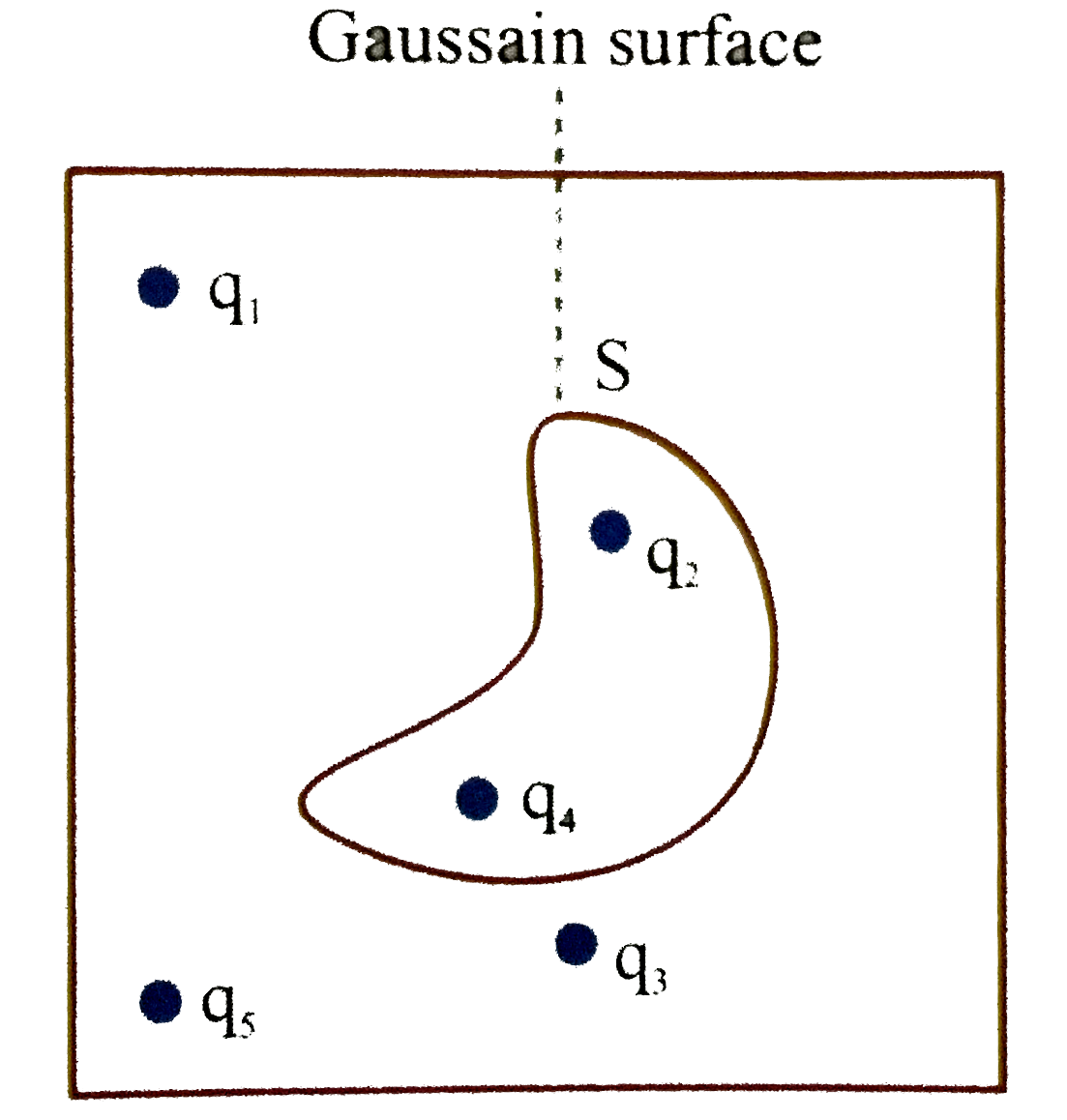
five charge `q_(1),q_(2),q_(3),q_(4)`and `q_(5)` are fixed at their positions as shown in figure .`s` is Gaussian surface .The Gauss's law is given by `ointvec(E).vec(ds)=(q)/(epsilon_(0))`

Which of the following statement is correct?

A

E on the LHS of the above equation will have a contribution from `q_1,q_5 and q_1,q_5 and q_3` while q on the RHS will have a contribution from `q_2 and q_4` only

B

E on the LHS of the above equation will have a contribution from all charges while q on the RHS will have a contribution from `q_2 and q_4` only

C

E on the LHS of the above equation will have a contribution from all charges while q on the RHS will have a contribution from `q_1,q_3 and q_5` only

D

Both E on the LHS and q on the RHS will have contributions from q2 and q4 only

Text Solution

Verified by Experts

The correct Answer is:

B

According to Gauss law, the term q on the right side of the equation `int_(s) E.dS =q/(epsilon_0)` includes the sum of all charges enclosed by the surface.
The charges may be located anywhere inside the surface, if the surface is so chosen that there are some charges inside and some outside, the electric field on the left side of equation is due to all the charges, both inside and outside S .
So, E on LHS of the above equation will have a contribution from all charges while q on the RHS will have a contribution from `q_2 and q_4` only.
Promotional Banner

Similar Questions

Explore conceptually related problems

q_(1),q_(2),q_(3) and q_(4) are point charges located at point as shown in the figure and s is a spherical Gaussian surface of radius R . Which of the following is true according to the Gauss's law

Consider Gauss's law oint vecE * vecd s = q/epsilon_0 Then, for the situation shown in figure at the Gaussian surface

Two fixed charges -2Q and +Q are located at points (-3a,0) and (+3a,0) respectively. Then which of the following statement is correct?

The value of charge q_1 ,q_2 and q_3 as shown in the figure are

In Gauss's law epsilon_(0)ointvec(E).bar(ds)= Q_("enclosed"), is vec(E) only due to charges enclosed ?

Assertion: Four point charges q_(1),q_(2),q_(3) and q_(4) are as shown in Fig,The flux over the shown Gaussians surface depends only on charges q_(1) and q_(2) Reason:Electric field at all points on Gaussians surface depends on any charges q_(1) and q_(2)

Assertion:- In a given situation of arrangement of charges, an extra charge is placed outside the Gaussion surface. In the Gauss Theroem ointvecEdvecs=(Q_(in))/(epsilon_(0))Q_(in) remains unchanged whereas electric field vecE at the site of the element is changed. Reason:- Electric field vecE at any point on the Gaussian surface is due to inside charge only.

Three charges -q_(1), +q_(2) and -q_(3) are placed as shown in the figure. The x -component of the force on -q_(1) is proportional to

Four point charges Q.q Q and q are placed at the corners of a square side 'a' as shown in the figures. Find the resultant electric force on a charge Q,
