Home
Class 12
PHYSICS
A disc of radius a//4 having a uniformly...

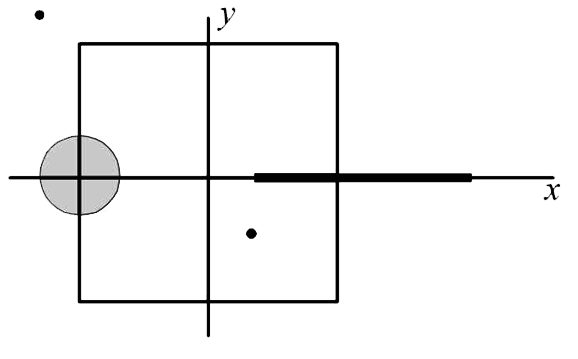
A disc of radius `a//4` having a uniformly distributed charge `6C` is placed in the x-y plane with its centre at `(-a//2, 0, 0)`. A rod of length a carrying a uniformly distributed charge 8C is placed on the x-axis from `x=a//4` to `x=5a//4`. Two point charges `-7C` and `3C` are placed at `(a//4, -a//4, 0)` and `(-3a//4, 3a//4, 0)`, respectively. Conisder a cubical surface formed by isx surfaces `x=+-a//2`, `y=+-a//2`, `z=+-a//2`. The electric flux through this cubical surface is

A

`(-2C)/(epsilon_(0))`

B

`(2C)/(epsilon_(0))`

C

`(10C)/(epsilon_(0))`

D

`(12C)/(epsilon_(0))`

Text Solution

Verified by Experts

The correct Answer is:

A

Total charge inside cube
`=3C+(8C)/(a)xx(a)/(4)-7C=3C+2C-7C=-2C`
Flux through the surface `phi=(1)/(epsilon_(0))Q=(-2c)/(epsilon_(0))`.
Promotional Banner

Similar Questions

Explore conceptually related problems

" Two point charges "+2q" and "-q" are placed on "x" -axis at "(0,0,0)" and "(3,0,0)" respectively,How many points of zero electric potential are there in the plane "X=5?

A charge q=10muC is distributed uniformly over the circumference of a ring of radius 3m placed on x-y placed with its centre art origin. Find the electric potential at a point P(0,0,4m)

An electrical charge 2xx10^-8 C is placed at the point (1,2,4) m. At the point (4,2,0) m, the electric

Two charges of "5C" and "-2C" are situated at the points "(3a,0)" and "(-5a,0) respectively.The electric flux through a sphere of radius ' "4a'" having center at origin is:

Point charges +4q, -q are kept on the x -axis at points x=0,x=a and X=2a respectively, then

A line charge having a linear charge density of 3 xx 10^-6 C/m is placed as shown in figure. A dipole is placed on x-axis as shown. Find the charge q if it is subjected to a force of 4N.

Knowledge Check

  • A disc of radius a//4 having a uniformly distributed charge 6C is placed in X-Y plane with its centre at (-a//2,0,0) .A rod of length a carrying a uniformly distributed charge 8C is placed on the X-axis from x = a//4 to x = 6a//4 . Two point charges -7 C and 3 C are placed at ((a)/(4) , - (a)/(4) . 0) and (-(3a)/(4) , 0) respectively. Consider a cubical surface formed by six surfaces x = +- (a)/(2) , y = +- (a)/(2), z = +- (a)/(2) . The electric flux throgh the cubical surface is

    A
    `-2 C//in_(0)`
    B
    `2 C//in_(0)`
    C
    `10 C//in_(0)`
    D
    `12 C//in_(0)`
  • A disk of radius a / 4 having a uniformly distributed charge 6 C is placed in the x - y plane with its centre at (–a / 2, 0, 0). A rod of length a carrying a uniformly distributed charge 8 C is placed on the x-axis from x = a /4 to x = 5a / 4. Two point charges – 7 C and 3 C are placed at (a / 4, – a /4, 0) and (– 3a /4, 3a / 4, 0), respectively. Consider a cubical surface formed by six surfaces x = pm a / 2, y = pm a / 2, z = pm a / 2. The electric flux through this cubical surface is

    A
    `(-2 C)/(epsi _(0))`
    B
    `(2 C)/( epsi _(0))`
    C
    `(10 C)/( epsi _(0))`
    D
    `(12 C)/( epsi _(0))`
  • Point charges + 4q, -q and + 4q are kept on the x- axis at points x = 0, x = a and X = 2a respectively, then

    A
    Only `q` is in stable equilibrium
    B
    None of the charges are in equilibrium
    C
    All the charges are in unstable equilibrium
    D
    All the charges are in stable equilibrium
