Home
Class 12
PHYSICS
A uniformly charged disc of radius R hav...

A uniformly charged disc of radius R having surface charge density `sigma` is placed in the xy plane with its center at the origin. Find the electric field intensity along the z-axis at a distance Z from origin :

A

`E=(2epsilon_(0))/(sigma)((1)/((Z^(2)+R^(2))^(1//2))+Z)`

B

`E=(sigma)/(2epsilon_(0))(1+(Z)/((Z^(2)+R^(2))^(1//2)))`

C

`E=(sigma)/(2epsilon_(0))(1-(Z)/((Z^(2)+R^(2))^(1//2)))`

D

`E=(sigma)/(2epsilon_(0))((1)/((Z^(2)+R^(2)))+(1)/(Z^(2)))`

Text Solution

Verified by Experts

The correct Answer is:
C

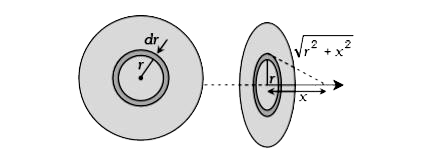
The disc can be considered to be a collection of large number of concentric rings. Consider an element of the shape of rings of radius r and of width dr. Electric field due to this ring at P is
`dE=(K.sigma2pir.dr.x)/((r^(2)+x^(2))^(3//2))`

Put, `r^(2)+x^(2)=y^(2)`
`2rdr=2ydy`
`therefore dE=(K.sigma2piy.dy.x)/(y^(3))=2Ksigmapi.x(ydy)/(y^(3))`
Electric field at P due to all rings is along the axis,
`therefore E=intdE`
`=2Ksigmapixunderset(x)overset(sqrt(R^(2)+x^(2)))int(1)/(y^(2))dy=2Ksigmapix.[-(1)/(y)]_(x)^(sqrt(R^(2)+x^(2)))`
`=2Ksigmapix[+(1)/(x)-(1)/(sqrt(R^(2)+x^(2)))]=2Ksigmapi[1-(x)/(sqrt(R^(2)-x^(2)))]`
`=(sigma)/(2epsilon_(0))[1-(x)/(sqrt(R^(2)+x^(2))]]` along the axis.
Promotional Banner

Similar Questions

Explore conceptually related problems

A disc is kept on xy plane with centre at origin. Find electric field at a point with distance Z from origin on z-axis.

A point charge q is placed at the origin . How does the electric field due to the charge very with distance r from the origin ?

A uniformly charged square plate having side L carries a uniform surface charge density sigma . The plate lies in the y - z plane with its centre at the origin. A point charge q lies on the x-axis. The flux of the electric field of q through the plate is phi0 , while the foce on the point charge q due to the plate is F_(0) , along the x-axis. Then,

A non conducting infinite rod is placed along the z- axis the upper half of the rod (lying along z ge 0 ) is charged positively with a uniform linear charge density +lambda , while the lower half ( z lt 0 ) is charged negatively with a uniform linear charge density -lambda . The origin is located at the junction of the positive and negative halves of the rod. A uniformly charged annular disc (surface charge density : sigma_(0) ) of inner radius R and outer radius 2R is placed in the x-y plane with its centre at the origin. find the force on the rod due to the disc.

A uniformly charged non conducting disc with surface charge density 10nC//m^(2) having radius R=3 cm . Then find the value of electric field intensity at a point on the perpendicular bisector at a distance of r=2cm

If sigma is surface density of charge on the charged cylinder of radius R, then electric intensity E at outer point at a distance r from its axis is

A sphere of radius R has a charge density sigma . The electric intensity at a point at a distance r from its centre is

