Home
Class 11
PHYSICS
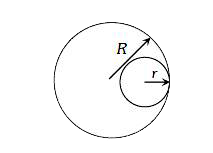
A spherical cavity of radius r is carved...

A spherical cavity of radius r is carved out of a uniform solid sphere of radius R as shown in the figure. The distance of the center of mass of the resulting body from that of the solid sphere is given by

A

`(R- r)/(2)`

B

0

C

`(R+ r)/(2)`

D

`(-r^(3))/(R^(2) + Rr + r^(3))`

Text Solution

Verified by Experts

The correct Answer is:

D

`X= ((-m)/(R^(3))r^(3) (R- r))/(m- (mr^(3))/(R^(3)))`
`(-mr^(3) (R- r))/(m(R^(3)-r^(3)))= (- mr^(3) (R- r))/(m(R- r)(R^(2) + Rr+ r^(2)))= (-r^(3))/(R^(2) + Rr + r^(3))`
Promotional Banner

Similar Questions

Explore conceptually related problems

A hemispherical cavity of radius R is created in a solid sphere of radius 2R as shown in the figure . Then y -coordinate of the centre of mass of the remaining sphere is

A hemi-spherical cavity is created in solid sphere (of radius 2R ) as shown in the figure. Then

A spherical cave of radius R/2 was carved out from a uniform sphere of radius R and original mass M. the center of the cave is at R/2 from the center of the large sphere. Point P is at a distance 2R from the center the large sphere and on the joing line of the two centers. the gravitational field strength g at point P is

A uniform solid sphere of radius R has a cavity of radius 1m cut from it if centre of mass of the system lies at the periphery of the cavity then

As shown in figure, when a spherical cavity (centered at O) of radius 2 is cut out of a uniform sphere of radius R (centered at C), the centre of mass of remaining (shaded) part of sphere is at G, i.e, on the surface of the cavity. R can be determined by the equation:

The radius of gyration of a solid sphere of radius R about its tangential is

A solid non-conducting sphere of radius R is charged with a uniform volume charge density rho . Inside the sphere a cavity of radius r is made as shown in the figure. The distance between the centres of the sphere and the cavity is a. An electron of charge 'e' and mass 'm' is kept at point P inside the cavity at angle theta = 45^(@) as shown. If at t = 0 this electron is released from point P, calculate the time it will take to touch the sphere on inner wall of cavity again.
