Home
Class 11
PHYSICS
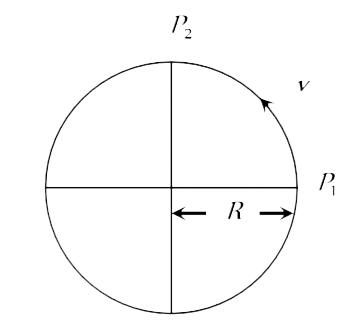
Figure below shows a body of mass M movi...

Figure below shows a body of mass `M` moving with the uniform speed on a circular path of radius, `R`. What is the change in acceleration in going from `P_(1)` to `P_(2)`

A

Zero

B

`v^(2)//2R`

C

`2v^(2)//R`

D

`(v^(2))/(R) xx sqrt2`

Text Solution

Verified by Experts

The correct Answer is:

D

`Delta a= 2a sin ((theta)/(2))=2a xx sin 45^(@)= sqrt2a= sqrt2 (v^(2))/(R)`
Promotional Banner

Similar Questions

Explore conceptually related problems

Figure shows a body of mass m moving with a uniform speed v along a circle of radius r . The change in velocity in going from A to B is

A body of mass 1kg is moving with a uniform speed of 1m//s in a circular path of radius 1m . The external force acting on the body is

If a body is moving with a uniform speed v in a circle of radius 'r', then the angular acceleration of the body will be

A Particle of mass 'M' moves in a uniform circular path of radius 'r' with a constant speed 'v' then its centripetal acceleration is .

A particle of mass m moves with constant speed v on a circular path of radius r as shown in figure. The average force on it during its motion from A to B is

Define centripetal acceleration. Derive anexpression for the centripetal acceleration of a particle moving with uniform speed v along a circular path of radius r. Discuss the direction of this acceleration

A particle of mass M moves with constant speed along a circular path of radius r under the action of a force F. Its speed is

A body of mass 5kg is moving along a circle of a radius 1 m with a uniform speed of 5 m/s .What is the acceleration of body?

If a body moves along circular path of constant radius, then the magnitude of its acceleration will be

A particle of mass m moves with constant speed v on a circular path of radius r. Find magnitude of average force on it in half revolution.
