Home
Class 11
PHYSICS
A billiard ball, initially at rest, is g...


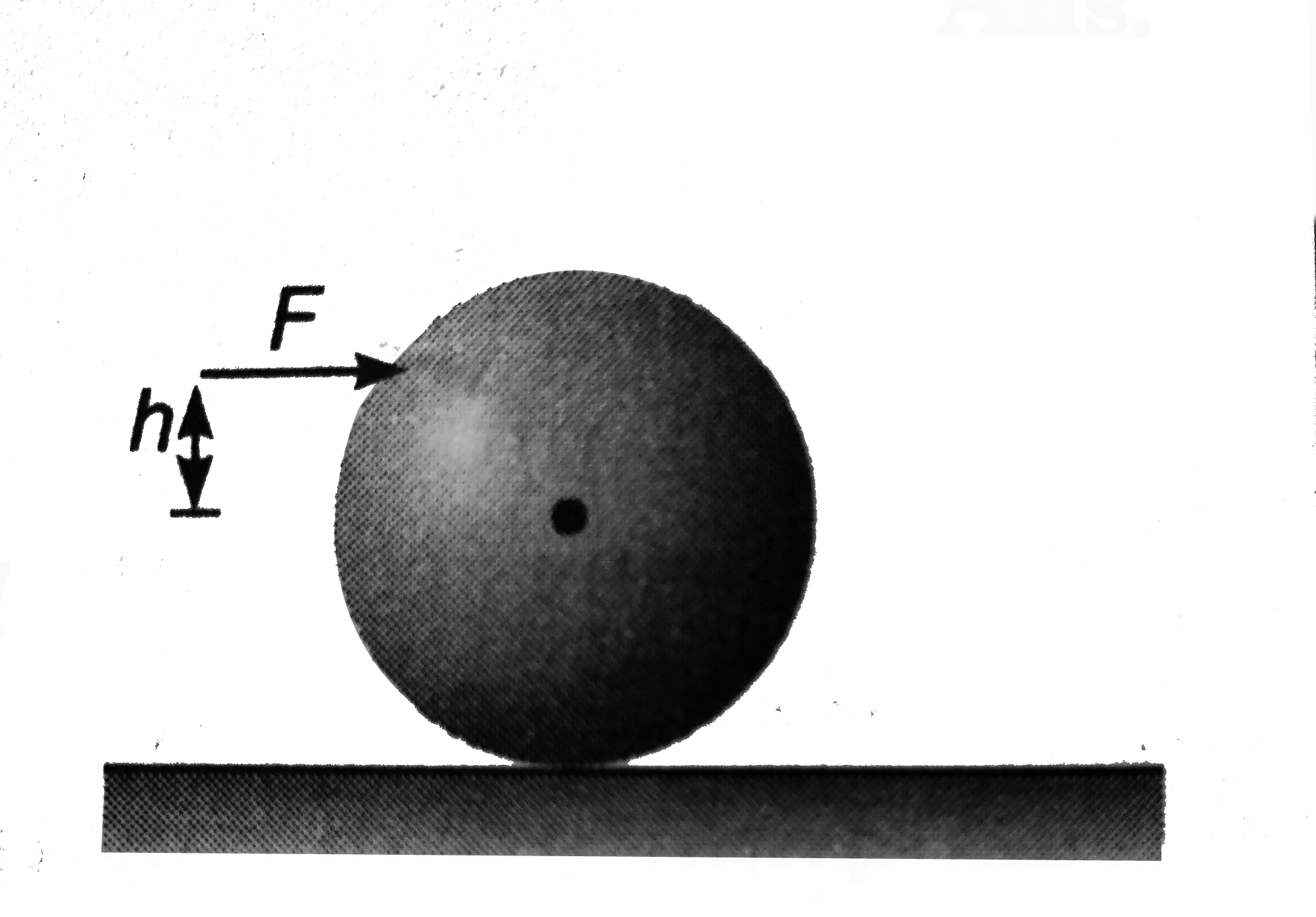
A billiard ball, initially at rest, is given a sharp impulse by a cue. The cue is held horizontally a distance `h` above the centre line as shown in figure. The ball leaves the cue with a speed `v_(0)` and because of its backward slipping eventually acquires a final
speed `(9)/(7)v_(0)` show that `h=(4)/(5)R`
Where `R` is the radius of the ball.

Text Solution

Verified by Experts

The correct Answer is:

`0.8`

Static frictional force acts in the forward direction because the point of contact has a tendency to slip backward. Due to frictional force, the linear velocity gradually decreases and the angular velocity increases till the ball starts rolling without sliding.
`mu mg=ma_(C.M.)impliesa_(C.M.)=mu g`
`:. v_(C.M.)=v_(@)-a_(C.M.)t=v_(@)-mu g t`
Considering the rotational motion about c.m.
`tau=mu mg R=((1)/(2)mR^(2))alphaimpliesalpha=(5mu g)/(2R)`
Using `omega=omega_(~)+alphatimpliesomega=0+(5mu g)/(2R)t=(5mu g t)/(2R)`
When the ball rolls without sliding
`v_(C.M.)=omegaR` or `v_(C.M.)=(5)/(2)mu g t `
`impliesv_(C.M.)=v_(!)-mu g.(2)/(5)(v_(C.M.))/(mu g)` or `v_(C.M.)=(5)/(7)v_(@)`
At this stage (when there is rolling without slipping) , the point of contact is the instantaneous point of rotation. The velocity of a point at a distance h above the central line is `v_(C.M.)+omegah`. This is `(9//7)v_(@)`.
`:.v_(C.M.)+omegah=(9)/(7)v_(@)` or `v_(C.M.)+(v_(C.M.))/(R)h=(9)/(7)v_(@)` `( :. omega=(v_(C.M.))/(R))`
`impliesv_(C.M.)(1+(h)/(R))=(9)/(7)v_(@)implies(5)/(7)v_(@)(1+(h)/(R))=(9)/(7)v_(0)`
`:.5+(5h)/(R)=9` or `h=(4)/(5)R=0.8R`.
Promotional Banner

Similar Questions

Explore conceptually related problems

A billiard ball, initially at rest, is given a sharp impulse by a cue. The cue is held horizontally a distance h above the centre line as shown in figure. The ball leaves the cue with a speed v_(0) and because of its forward english (backward slipping) eventually acquires a final speed (9)/(7)v_(0) show that h=(4)/(5)R Where R is the radius of the ball.

The cue stick hits a cue ball horizontally a distance x above the centre of the ball. Find the value of x for which the cue ball will instantaneously roll without slipping. Calculate the answer in terms of the radius R of the ball.

A solid shperical ball of mass m and radius R is present on a rough horizontal surface. A person hit the ball at distance h above the centre of the ball as shown in the figure. Find out the h such that the ball starts pure rolling just after impact.

A billiard ball of mass m and radius r, when hit in a horizontal direction by a cue at a height h above its centre, acquired a linear velocity v_(0). The angular velocity omega_(0) acquired by the ball is

A billiard ball is struck by a cue. The line of action of the applied impulse is horizontal andpasses through thecentre of theball. The initial velocityofthe ball is v_(0) . If is the radius, M is the mass of the ball and mu is the coefficient of friction between the ball and the floor, find how far the ball moves before it ceases to slip on the floor.

A particle of mass m moving horizontal with v_(0) strikes a smooth wedge of mass M, as shown in figure. After collision, the ball starts moving up the inclined face of the wedge and rises to a height h. The final velocity of the wedge v_(2) is

Five balls are placed one after the other along a straight line as shown in the figure. Initially, all the balls are at rest. Then the second ball has been projected with speed v_(0) towards the third ball. Mark the correct statements, (Assume all collisions to be head-on and elastic.)

A solid spherical ball of radius R collides with a rough horizontal surface as shown in figure. At the time of collision its velocity is v_(0) at an angle theta to the horizontal and angular velocity omega_(0) as shown . After collision, the angular velocity of ball may
