Home
Class 11
PHYSICS
A slab is subjected to two forces vec F(...

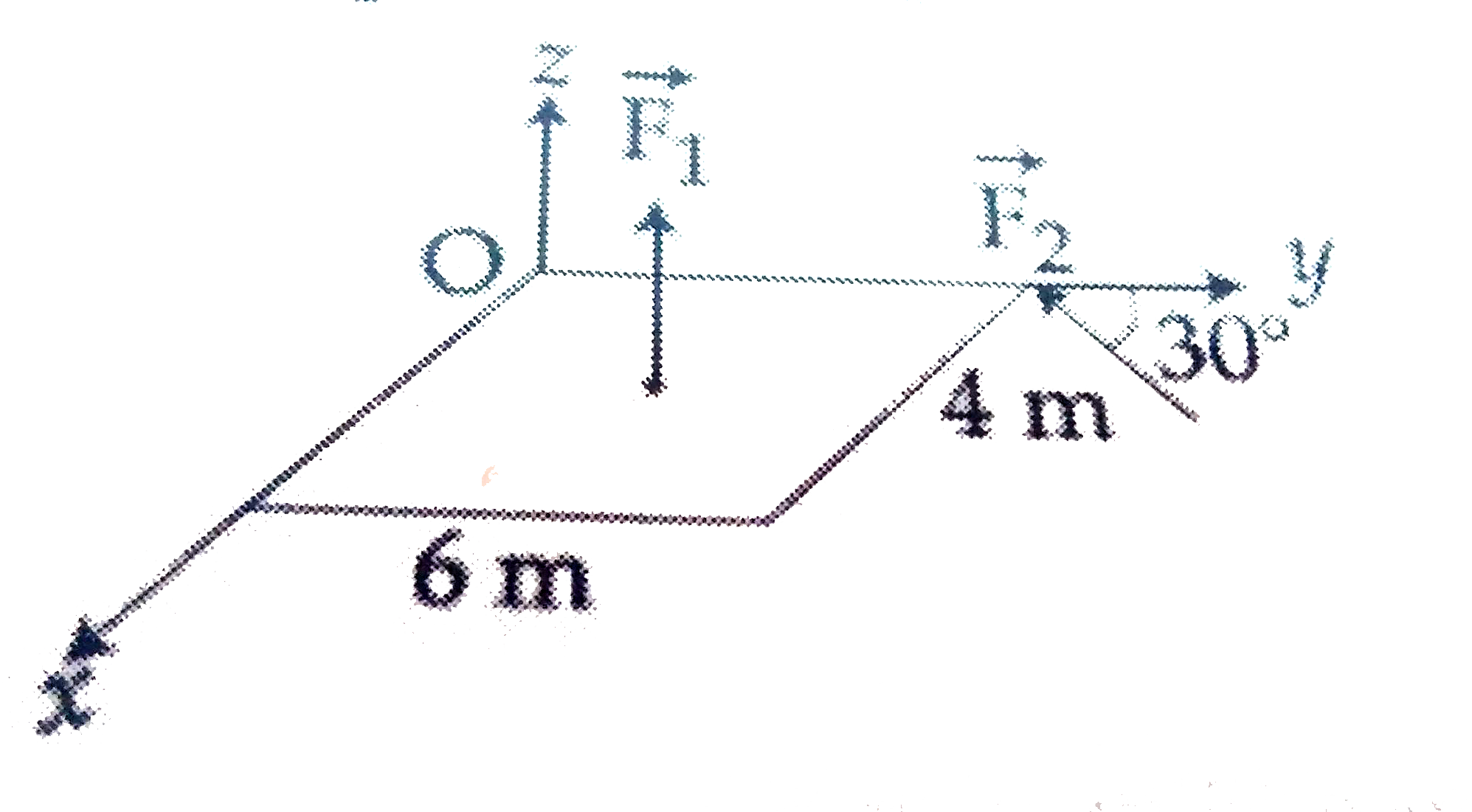
A slab is subjected to two forces `vec F_(1) and vec F_(2)` of same magnitude F as shown in the figure . Force `vec F_(2)` is in XY-plane while force `F_(1)` acts along z-axis at the point `(2 vec I + 3 vec j)` .The moment of these forces about point O will be :

A

`(3hati+2hatj+3hatk)F`

B

`(3hati+2hatj-3hatk)F`

C

`(3hati-2hatj-3hatk)F`

D

`(3hati-2hatj+3hatk)F`

Text Solution

Verified by Experts

The correct Answer is:

D

`tau_(0)=vecr_(1)xxvecF_(1)+vecr_(2)xxvecF_(2)`
`=(2hati+3hatj)xxF(hatk)+6hatjxx((F)/(2)(-hati)+(Fsqrt(3))/(2)(-hatj))`
`=2F(-hatj)+3F(hati)+3F(hatk)+0`
`=(3hati-2hatj+3hatk)F`
Promotional Banner

Similar Questions

Explore conceptually related problems

Two forces vec(F_(1)) and vec(F_(2)) are acting at right angles to each other , find their resultant ?

A force vec(F) = 3 hat(i) + 2hat(j) - 4hat(k) is applied at the point (1, -1, 2) . What is the moment of the force about the point (2 , -1, 3) ?

If vec F is the force acting in a particle having position vector vec r and vec tau be the torque of this force about the origin, then

A force vec(F)=3hat(i)+2hat(j)-4hat(k) is applied at the point (1, -1, 2) . Find the moment of vec(F) about the point (2, -1, 3) .

If a force F=3 i+2 j-4k is acting at the point P(1,-1,2) then the magnitude of moment of F about the point Q(2,-1,3) is

A smooth track in the form of a quarter circle of radius 6 m lies in the vertical plane. A particle moves from P_(1) to P_(2) under the action of forces vec F_(1),vecF_(2) and vec F_(3) Force vec F_(1) is 20N, Force vec F_(2) is always 30 N in magnitude. Force vec F_(3) always acts tangentiallly to the track and is of magnitude 15 N . Select the correct alternative (s) : .

Find the moment of vec F about point (2,-1,3), where force vec F=3hat i+2hat j-4hat k is acting on point (1,-1,2)

Two forces vec(F)_(1)=500N due east and vec(F)_(2)=250N due north have their common initial point. vec(F)_(2)-vec(F)_(1) is

A force vec(F)=4hat(i)+hat(k) acts through point A (0, 2, 0). Find the moment vec(m) of vec(F) about the point B (4, 0, 4).
