Home
Class 11
PHYSICS
An equilateral triangle ABC formed from ...

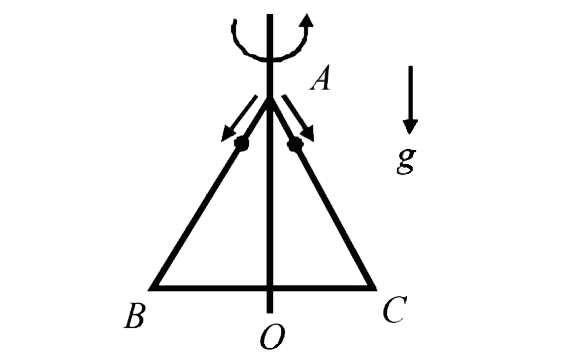
An equilateral triangle ABC formed from a uniform wire has two small identical beads initially located at A. The triangle is set rotating about the vertical axis AO. Then the beads are released from rest simultaneously and allowed to slide down, one along AB and the other along AC as shown. Neglecting frictional effects, the quantities that are conserved as the beads slides down, are

A

Angular velocity and total energy (kinetic and potential )

B

Total angular momentum and total energy

C

Angular velocity and moment of inertia about the axis of rotation

D

Total angular momentum and momnebt of inertia about the axis of rotation

Text Solution

Verified by Experts

The correct Answer is:

B

As beads slides down `I uarr omega darr`, but there is no external torque L = constant and energy is conserved because of no friction .
Promotional Banner

Similar Questions

Explore conceptually related problems

A equilaterial triangle ABC formed from a uniform wire has two small identical beads initially located at A . The triangle is set rotating about the vertical axis AO . Then the beads are released from rest simultaneously and allowed to slide down. one long. AB and the other along AC as shown. Neglecting frictional effects, the quantities that are conserved as the beads slide down, are. .

An equailaral triangle ABC formed from a uniform wire has two small identical beads initially located at A. The triangle is set rotating about the vertical axis AO. Then the beads are released from rest simultaneously and allowed to slide down, one along AB and the other along AC as shown. Neglectig frictional effects, the equatities that are conserved as the beads slids down, are

Two beads are released from A simultaneoulsy to slide along smooth AB and AC. Find the ratio of time taken by them to reach B and C respectively

A massless ring hangs from a thread and two beads of mass m slide it without friction. The beads are released simultaneously from the top of the ring and slide down along possible sides. Find the angle from vertical at which the ring will start to rise.

A wire, which passes through the hole in a small bead, is bent in the form of quarter of a circle. The wire is fixed vertically on ground as shown in the figure. The bead is released from near the top of the wire and it slides along the wire without friction. As the bead moves from A to B, the force it applies on the wire is

A ring of mass M hangs from a thread and two beads of mass m slides on it without friction. The beads are released simultaneously from the top of the ring and slides down in opposite sides. Show that the ring will start to rise, if mgt(3M)/(2) . ltbr.

A smooth wire is bent into a vertical circle of radius a. A bead P can slide smoothly on the wire. The circle is rotated about vertical diameter AB as axis with a speed omega as shown in figure. The bead P is at rest w.r.t. the circular ring in the position shown. then omega^(2) is equal to:

Two blocks of equal mass, M each, are connected to two ends of a massless string passing over a massless pulley. On one side of the string there is a bead of mass (M)/(2) . (a) When the system is released from rest the bead continues to remain at rest while the two blocks accelerate. Find the acceleration of the blocks. (b) Find the acceleration of the two blocks if it was observed that the bead was sliding down with a constant velocity relative to the string.

An L shaped thin uniform rod of total length 2l is free to rotate in a vertical plane about a horizontal axis a P as shown in the figure. The bas is released from rest. Neglect air and contact friction. The angular velociyt at the instant it has rotated through 90^@ and reached the dotted position shown is

Two long fixed parallel vertical conducting rails AB and CD are separated by a distance L. They are connected by resistance R and a capacitance C at two ends as shown in the figure. There is a uniform magnetic field B directed horizon- tally into the plane of the figure. A horizontal metallic bar of length L and mass m can slide without friction along the rails. The bar is released from rest at t = 0. Neglect resistance of bar and rails and also neglect the self inductance of the loop. (a) Find the maximum speed acquired by the bar after it is released. (b) Find the speed of the bar as a function of time t.
