Home
Class 12
PHYSICS
When a magnet is pushed in and out of a ...

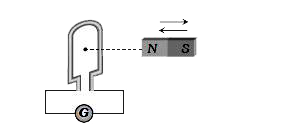
When a magnet is pushed in and out of a circular coil C connected to a very sensitive galvanometer G as shown in the adjoining diagram with a frequency v, then

A

Constant deflection is observed in the galvanometer

B

Visible small oscillations will be observed in the galvanometer if v is about 50 Hz

C

Oscillations in the deflection will be observed clearly if v = 1 or 2 Hz

D

No variation in the deflection will be seen if v = 1 or 2 Hz

Text Solution

Verified by Experts

The correct Answer is:

C

If frequency (f) is high then no deflection observed and at low frequency of 1 to 2Hz, oscillations may be observed as our eyes will be able to detect it.
Promotional Banner

Similar Questions

Explore conceptually related problems

A resistor R , an inductor L , a capacitor C and voltmeters V_(1),V_(2) and V_(3) are connected to an oscillator in the circuit as shown in the adjoining diagram.When the frequency of the oscillator is increased, upto resonance frequency, the voltmeter reading (at resonance frequency) is zero in the case of:

A circular metallic ring has a radius r. A battery of V volts is connected across the diameter of the ring as shown in the adjoining figure. Calculate the magnetic field at the centre of the coil.

What happens when the north pole of a magnet is moved towards the face of a coil connected to a galvanometer?

An accumulator of emf 2 V and negligible internal resistance is connected across a uniform wire of length 10 m and resistance 30 Omega The appropriate terminals of a cell of emf 1.5 V and internal resistance 1 Omega is connected to one end of the wire and the other terminal of the cell is connected through a sensitive galvanometer to a slider on the wire. What is the length of the wire that will be required to produce zero deflection of the galvanometer? How will the balancing length change? (a) When a coil of resistance 5Omega is placed in series with the accumulator. (b) The cell of 1.5 V is shunted with 5 Omega resistor?

The north pole of a long bar magnet was pushed slowly into a short solenoid connected to a galvanometer. The magnet was held stationery for a few seconds with the north pole in the middle of the solenoid and then withdrawn rapidly. The maximum deflection of the galvanometer was observed when the magnet was :

The north pole of a long bar magnet was pushed slowly into a short solenoid connected to a galvanmeter. The magnet was held stationary for a few seconds with the north pole in the middle of the solenoid and then withdrawn repidly. The maximum deflection of the galvanometer was observed when the magnet was

A magnet N-S is suspened from a spring and when it oscillates, the magnet moves in and out of the ocil C. the coil is connected to a galvanometer G. then, as the magnetic oscillates

What happens when the north pole of a magnet is moved away from the coil connected to a galvanometer? (draw appropriate labelled diagrams)
