Home
Class 12
PHYSICS
The north and south poles of two identic...

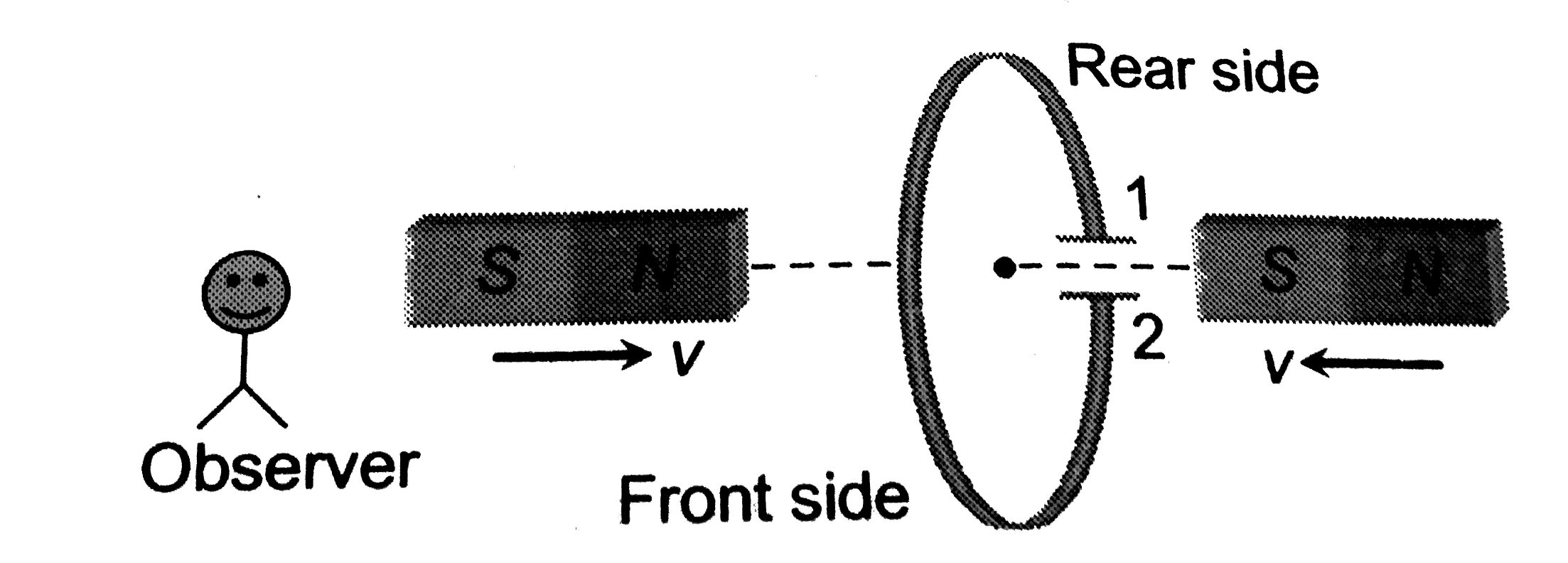
The north and south poles of two identical magnets approach a coil, containing a condenser, with equal speeds from opposite sides. Then

A

Plate 1 will be negative and plate 2 positive

B

Plate 1 will be positive and plate 2 negative

C

Both the plates will be positive

D

Both the plates will be negative

Text Solution

Verified by Experts

The correct Answer is:

B

Plate 1 will be positive and plate 2 negative
Promotional Banner

Similar Questions

Explore conceptually related problems

The north and south poles of two indential magnets approach a coil, containing a condenser,with equal speeds from opposite sides. Then

(a). Predict the polarity of capacitor C as shown in Fig. 3.26 when poles S and N of two identical magnets approach the coil from opposote sides with equal velocity. The plane of the loop containing the capacitor is perpendicualr to the plane of the paper. (b). A magnetic field perpendicular to the plane of a rectangular frame of wire is concentrated about O . If the field decreases, will there be any emf induced in loop 1 ? What about loop 2 ? Explain why.

Are the two poles of a magnet equally strong?

Two north poles each of pole strength m and a south pole of pole strength m are placed at the three corners of an equilateral triangle of side a. The intensity of magnetic induction field strength at the centre of the triangle is

The figure below shows the north and south poles of permanent magnet in which n turn coil of area of cross-section A is resting, such that for a current I passed through the coil, the plane of the coil makes an angle with respect to the direction of magnetic field B . If the plane of the magnetic field and the coil are horizontal and vertical respectively, the torque on the coil will be

The north pole of a magnet is brought near a coil. The induced current in the coil as seen by an observer on the side of magnet will be-

When the north pole of a magnet is moved away from a coil, what is the direction of current induced in a coil?
