Home
Class 12
PHYSICS
A wire cd of length l and mass m is slid...

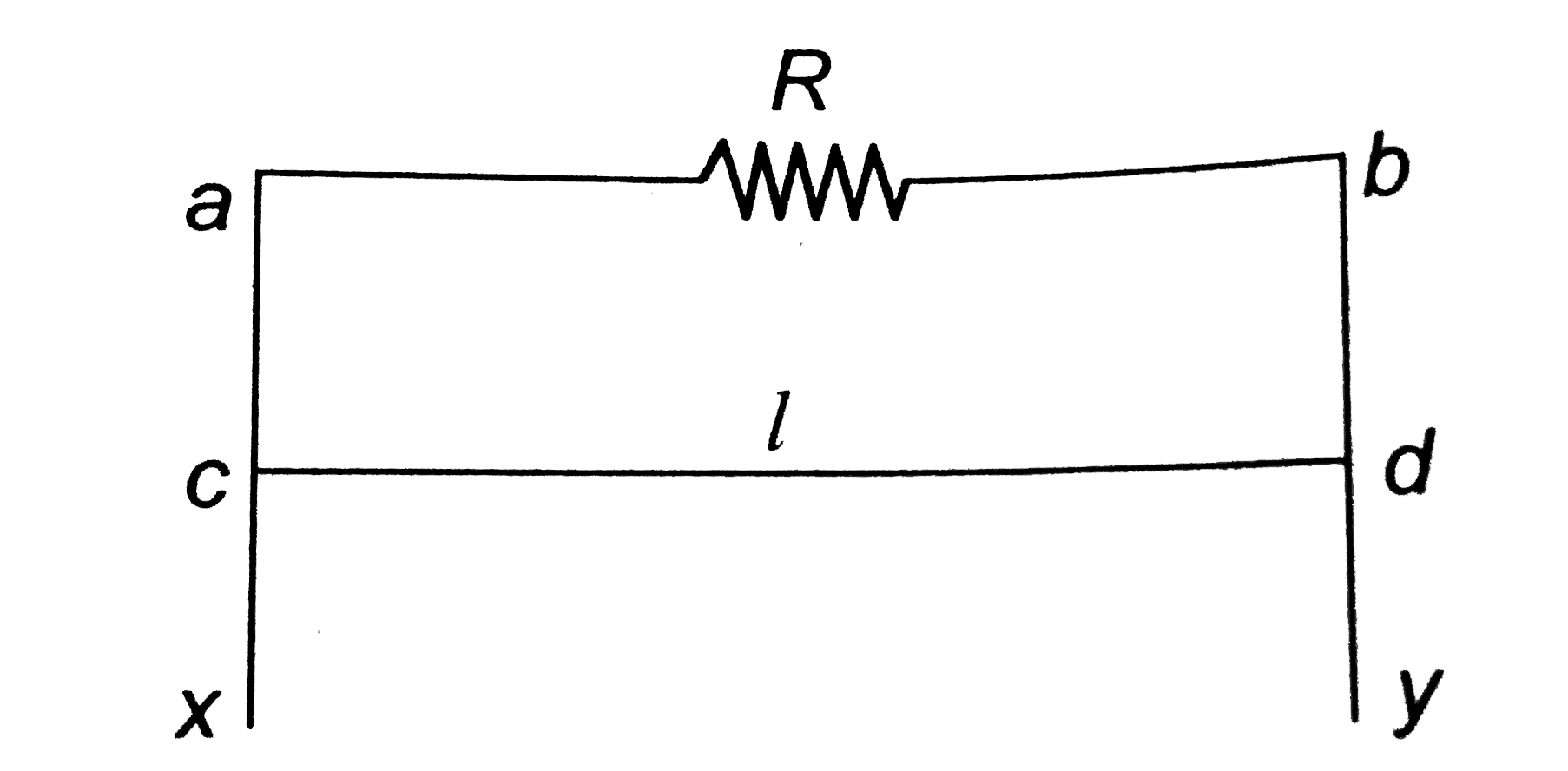
A wire `cd` of length `l` and mass `m` is sliding without friction on conducting rails `ax` and by as shown. The verticle rails are connected to each other with a resistance `R` between `a` and `b`. A uniform magnetic field `B` is applied perpendicular to the plane `abcd` such that `cd` moves with a constant velocity of

A

`(mgR)/(Bl)`

B

`(mgR)/(B^(2)l^(2))`

C

`(mgR)/(B^(3)l^(3))`

D

`(mgR)/(B^(2)l)`

Text Solution

Verified by Experts

The correct Answer is:

B

Due to B, force (upward)
`F=BIl=B((Blv)/R)l=(B^(2)l^(2)v)/R`
If slides with constant velocity -
Then, `(B^(2)l^(2)v)/R=mgrArrv=(mgR)/(B^(2)l^(2))`.
Promotional Banner

Similar Questions

Explore conceptually related problems

A conducting wire xy of lentgh l and mass m is sliding without friction on vertical conduction rails ab and cd as shown in figure. A uniform magnetic field B exists perpendicular to the plane of the rails, x moves with a constant velocity of

A wire of length l , mass m and resistance R slides without any friction down the parallel conducting rails of negligible resistance . The rails are connected to each other at the bottom by a resistanceless rail parallel to the wire so that the wire and the rails form a closed rectangualr conducting loop. The plane of the rails makes an angle theta with the horizontal and a uniform vertical magnetic field of the inducetion B exists throughout the rregion. Find the steady state velocity of the wire.

A conducting wire ab of length l resistance r and mass m starts sliding down at t=0 on a smooth, vertical thick pair of connected rails as shown. The terminal speed of the wire is

A horizontal wire is free to slide on the verticle rails of a conducting frame as shown in figure. The wire has a mass m and length l and the resistance of the circuit is R . If a uniform magnetic field B is directed perpendicular to the frame, the terminal speed of the wire as it falls under the force of gravity is

A conducting rod of mass m and length l is free to move without friction on two parallel long conducting rails, as shown below. There is a resistance R across the rails. In the entire space around, there is a uniform magnetic field B normal to the plane of the rod and rails. The rod is given an impulsive velocity v_(0) - Finally, the initial energy (1)/(2) mv_(0)^(2)

A conductor of length l and mass m can slide without any friction along the two vertical conductors connected at the top through a capacitor. A uniform magnetic field B is set up _|_ to the plane of paper. The acceleration of the conductor
