Home
Class 12
PHYSICS
A conducting rod of mass m and length l ...

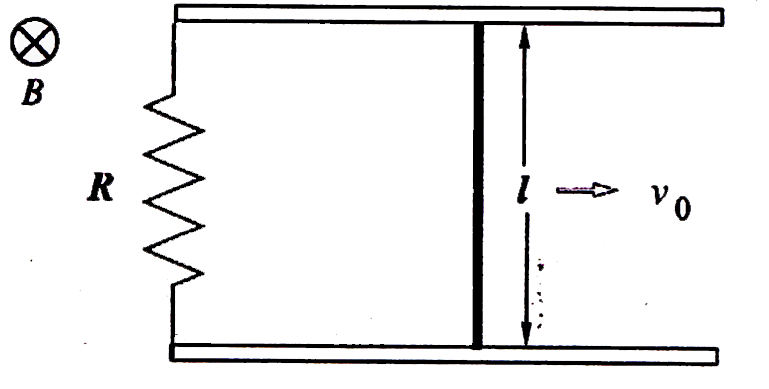
A conducting rod of mass m and length l is free to move without friction on two parallel long conducting rails, as shown below. There is a resistance R across the rails. In the entire space around, there is a uniform magnetic field B normal to the plane of the rod and rails. The rod is given an impulsive velocity `v_(0)`-

Finally, the initial energy `(1)/(2) mv_(0)^(2)`

A

Will be converted fully into heat energy in the resistor

B

Will enable rod to continue to move with velocity `v_(0)` since the rails are frictionless

C

Will be converted fully into magnetic energy due to induced current

D

Will be converted into the work done against the magnetic field

Text Solution

Verified by Experts

The correct Answer is:

A

Due to the negative work on rod . .EK will decrease and finally become zero.
Promotional Banner

Similar Questions

Explore conceptually related problems

Shows a rod of length l and resistance r moving on two rails shorted by a resistance R . A uniform magnetic field B is present normal to the plane of rod and rails. Show the electrical equivalence of each branch.

A wire cd of length l and mass m is sliding without friction on conducting rails ax and by as shown. The verticle rails are connected to each other with a resistance R between a and b . A uniform magnetic field B is applied perpendicular to the plane abcd such that cd moves with a constant velocity of

A conducting bar of mass m and length l moves on two frictionless parallel rails in the presence of a constant uniform magnetic field of magnitude B directed into the page as shown in the figure . The bar is given an initial velocity v_(0) towards the right at t = 0. Then the

A conductor rod AB of mass m slides without friction over two long conducting rails separated by a distance (Fig) At the left end the raidls are interconnected by a resistance R . The system is located in a unifrom magnetic fileld perpendicular to the plane of the loop. At the moment t = 0 the rod AB starts moving to the right with an initial velocity v_(0) . Neglecting the resistances of the rails and the rod AB , as wellas the self -indcuctance, find: (a) the distance covered by the rod until it comes to a standsill, (b) the amount of heat generated in the resitance R during this process.

Shows rod PQ of mass m and resistance r moving on two fixed, resistanceless, smooth conducting rails (closed on both sides by resistances R_(1) and R_(2) ). Find the current in the rod (at the instant its velocity is v ).

A conducting rod of resistance r moves uniformly with a constant speed v in a uniform magnetic field. If the rod keeps moving uniformly, then the amount of force required is
