Home
Class 12
PHYSICS
In a photocell circuit the stopping pote...

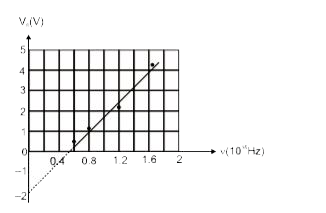
In a photocell circuit the stopping potential, `V_0`, is a measure of the maximum kinetic energy of the photoelectrons. The following graph shows experimentally measured values of stopping potential versus frequency v of incident light.

The values of Planks constant and the work function as determined from the graph are (taking the magnitude of electronic charge to be `e= 1.6 xx 10^(-19)C`)

A

`6.4 xx10^(-34) Js,2.0 eV`

B

`6.0 xx10^(-34) Js,2.0 eV`

C

`6.4 xx10^(-34) Js,3.2 eV`

D

`6.0 xx10^(-34) Js,3.2 eV`

Text Solution

Verified by Experts

The correct Answer is:

B

`V=(hv)/e-phi`
Hence from graph `phi=2eV`
`h/e` = Slope
`=6/(1.6 xx10^(15))implies h=(6xx1.6 xx10^(-19))/(1.6 xx10^(15))=6.0 xx10^(-34)`
Promotional Banner

Similar Questions

Explore conceptually related problems

Draw a graph showing the variation of stopping potential with frequency of the incident on a metal plate. How can the value of Planck's constant be determined from this graph?

The following figure shows a graph for the stopping potential as a function of the frequency of incident light illuminating a metal surface. Find the photoelectric work function for this surface.

From the graph shown, the value of work function if the stopping potential (V) , and frequency of the incident light v are on y and x -axes respectively is

When ultraviolet light is incident on a photocell, its stopping potential is V_(0) and the maximum kinetic energy of the photoelectrons is K_(max) . When X-rays are incident on the same cell, then:

In an experiment on photoelectric effect the frequency f of the incident light is plotted against the stopping potential V_(0) . The work function of the metal is given by ( e is the electronic charge)

The graph shows variation of stopping potential V_(0) versus frequency of incident radiation v for two photosensitive metals A and B . Which of two metals has higher threshold frequency and why?

Draw a graph showing the variation of stopping potential with frequency of the incident radiation. What does the slope of the line with frequency axis indicate? What information can be obtained from the values of intercept on the potential axis?
