Home
Class 12
PHYSICS
A photon of wavelength lamda is absorbe...

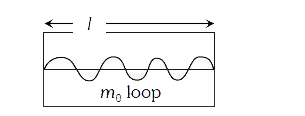
A photon of wavelength `lamda` is absorbed by an electron confined to a box of length `sqrt(35hlamda//8mc)` . As a result, the electron makes a transition from state k = 1 to the state n Subsequently the electron transits from the state n to the state m by emitting a photon of wavelength `lamda = 1.75lamda` then

A

`n = 4 :m = 2`

B

`n = 5 :m = 3`

C

`n = 6 :m = 4`

D

`n = 3 :m = 1`

Text Solution

Verified by Experts

The correct Answer is:
C

KE of `e^(-) = (hc)/lamda`

`lamda_("de - Broglie") =h/(sqrt(2mKE))=h/(sqrt(2mxx(hc)/lamda))=(sqrt(hlamda))/(sqrt(2mc))`
`(m_0lamda_("de-Broglie"))/2=l`
`impliesm_0/2xxsqrt((hlamda)/(2mc))=sqrt(35hlamda)/(sqrt(8mc))implies m_0=sqrt35=5.8 ~~6`
i.e. `e^(-)` get excite to state 6, `:. n = 6`
Promotional Banner

Similar Questions

Explore conceptually related problems

A photon of wavelength lambda is absorbed by an electron confined to a box of length sqrt(35hlambda//8mc) . . As a result, the electron makes a transition from state k = 1 to the state n. Subsequently the electron transits from the state n to the state m by emitting a photon of wavelength lambda'=1.85lambda . Then

When an electron makes a transition from (n+1) state of nth state, the frequency of emitted radistions is related to n according to (n gt gt 1) :

When an electron makes a transition from (n + 1) state to n state the frequency of emitted radiation is related to n according to (n gtgt 1)

The wavelength of the photon emitted by a hydrogen atom when an electron makes a transition from n = 2 to n = 1 state is :

An electron in C^(5+) ion during the transition from n = 3 to n = 1 emits light of wavelength

The electron in a hydrogen atom at rest makes a transition from n = 2 energy state to the n = 1 ground state. find the energy (eV) of the emitted photon.

n' photons of wavelength 'lamda' are absorbed by a black body of mass 'm'. The momentum gained by the body is

What is the wavelength of a photon emitted during a transition from n = 5 state to the n = 2 state in the hydrogen atom

An electron makes transition form n=3 , n=1 state in a hydrogen atom. The maximum possible number of photons emitted will be

