Home
Class 12
PHYSICS
In a historical experiment to determine ...

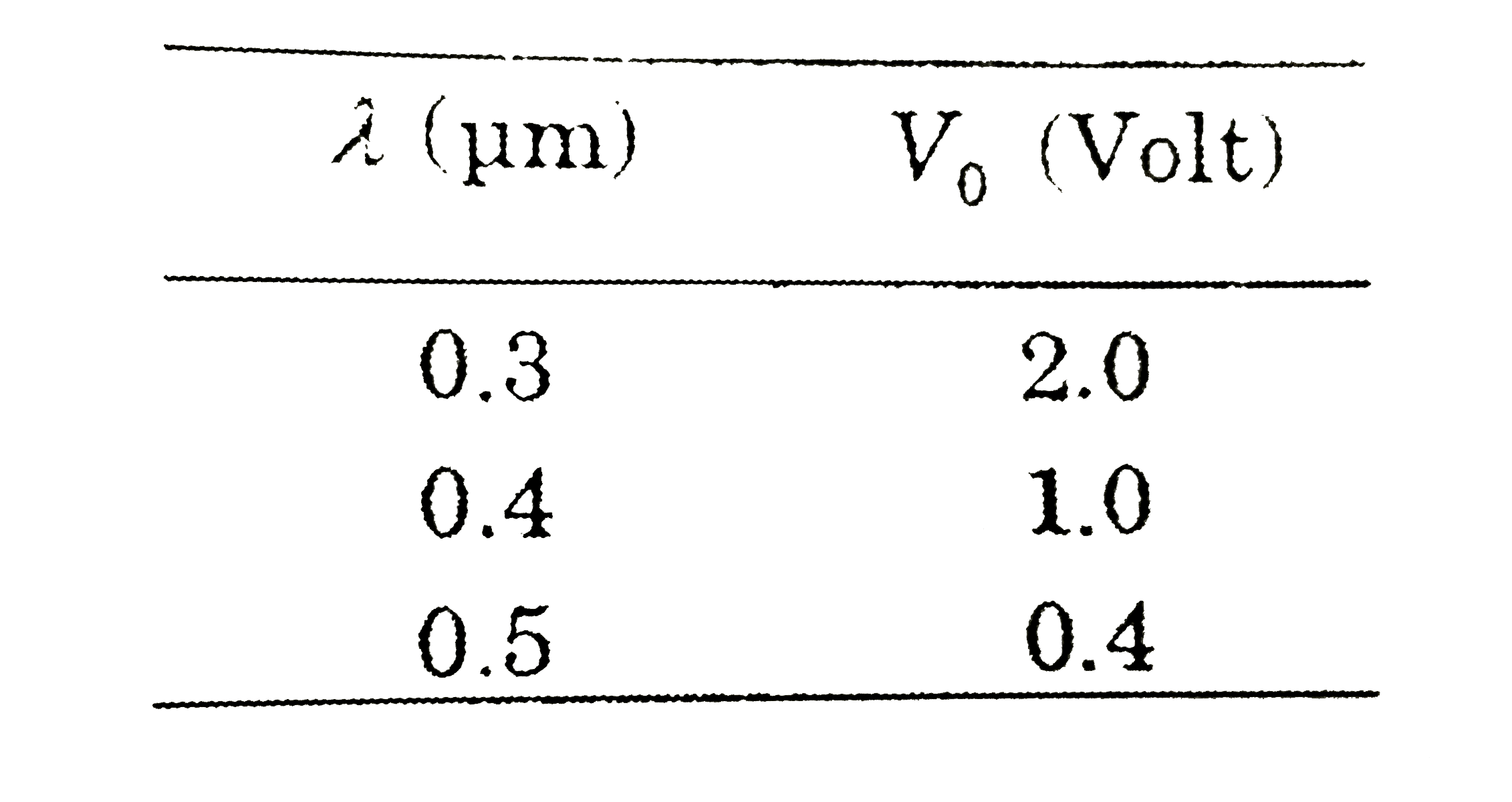
In a historical experiment to determine Planck's constant, a metal surface was irradiated with light of different wavelengths. The emitted photoelectron energies were measured by applying a stopping potential. The relevant data for the wavelength `(lambda)`. ) of incident light and the corresponding stopping potential `(V_0 )` are given below :

Given that `c=3xx10^8ms^(-1) and e=1.6xx10^(-19)C` Planck's constant (in units of J s) found from such an experiment is

A

`6.0 xx 10^(-34)`

B

`6.4 xx 10^(-34)`

C

`6.6 xx 10^(-34)`

D

`6.8 xx 10^(-34)`

Text Solution

Verified by Experts

The correct Answer is:

B

`K_("max") =(hc)/lambda -phi_(0)rArreV = (hc)/lambda -phi`
`rArr e(V_(1)-V_(2))=(hc)/(lambda_(1))-(hc)/(lambda_(2))`
`rArr h = (e(V_(1)-V_(2))lambda_(1)lambda_(2))/(c(lambda_(2)-lambda_(1)))`
`=(1.6 xx 10^(-19)xx1xx0.3 xx0.4 xx 10^(-6)xx10^(-6))/(3xx10^(8)xx0.1xx10^(-6))`
`= 6.4 xx 10^(-34)`
Promotional Banner

Similar Questions

Explore conceptually related problems

In a historical experiment to determine Planck's constant, a metal surface was irradiated with light of different wavelengths. The emitted photoelectron energies were measured by applying a stopping potential. The relevant data for the wavelength (lambda) . ) of incident light and the corresponding stopping potential (V_0 ) are given below : ltimg src="https://d10lpgp6xz60nq.cloudfront.net/physics_images/JA_16_PHY_P1_E01_001_Q01.png" width="80%"gt Given that c=3xx10^8ms^(-1) and e=1.6xx10^(-19)C Planck's constant (in units of J s) found from such an experiment is

When light of wavelength 400nm is incident on the cathode of photocell, the stopping potential recorded is 6V. If the wavelength of the incident light is to 600nm, calculate the new stopping potential. [Given h=6.6xx10^(-34) Js, c=3xx10^(8)m//s , e=1.6xx10^(-19)C ]

When a metalic surface is illuminated with light of wavelength lambda, the stopping potential is V. the same surface is illuminated by light of wavelength 2lambda the stopping potential is (V)/(3) The thershold waelength for the surface is

When a metal is illuminated by light of wavelength lambda , the stopping potential is V_@ and for wavelength 2lambda , it is 3V_@ .Then the threshold wavelength is ?

When a certain metallic surface is irradiated with monochromatic light wavelength lambda , the stopping potential for photoelectric current is 3 V_(0) . When the same surface is irradiated with light of wavelength 2 lambda , the stopping potential is V_(0) The threshold wavelength for the given surface is

When light of wavelength lambda is incident on photosensitive surface, the stopping potential is V. When light of wavelength 3lambda is incident on same surface, the stopping potential is V/6 Thereshould wave length for the surface is

Metal surface emits photoelectrons when light of wavelength 400 nm is incident on it. Calculate the work function of the metal if stopping potential is 0.5 V.

When a metallic surface is illuminated with monochromatic light of wavelength lambda stopping potential for photoelectric current is 3 V_(0) . When the same metal surface Illuminated with a light of wavelength 2lambda , the stopping potential is V_(0) The threshold wavelength for the surface is

Light of wavelength 3 xx 10^(-7) m is incident on a photosensitive surface . The stopping potential for emitted photoelectrons is 2.5 V . If the wavelength of incident light is reduced to 1.5 xx 10^(-7) m , the stopping potential for emitted photoelectrons is
