Home
Class 12
CHEMISTRY
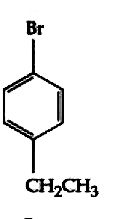
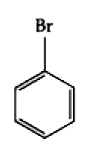
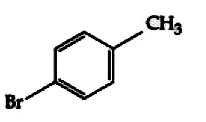
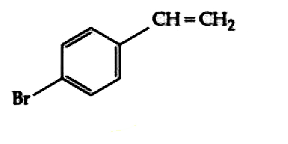
A Aunderset((ii) CN^(-))overset((i)Cl(2)...

A `Aunderset((ii) CN^(-))overset((i)Cl_(2)Delta)to`
(iii) `H_(2)O"/"H^(+)` 4-Bromophenyl acetic acid.
In the above reaction 'A' is

A

B

C

D

Text Solution

AI Generated Solution

The correct Answer is:

To determine the reactant 'A' that leads to the formation of 4-Bromophenylacetic acid through the given reactions, we can break down the steps as follows: ### Step-by-Step Solution: 1. **Identify the Final Product**: The final product is 4-Bromophenylacetic acid. This compound has a bromine atom at the para position (4-position) of the phenyl ring and an acetic acid functional group. 2. **Analyze the Reagents**: The reagents provided are: - Cl₂ (chlorine gas) with heat - CN⁻ (cyanide ion) - H₂O/H⁺ (acidic hydrolysis) 3. **Determine the Starting Material**: To obtain 4-Bromophenylacetic acid, we need to consider the first step involving chlorination. The presence of bromine in the final product suggests that we need a compound that can undergo chlorination to introduce a chlorine atom at the para position. 4. **Propose the Initial Compound**: A suitable starting compound that contains a bromine atom and can undergo chlorination is 4-Bromotoluene (p-bromotoluene). The structure of 4-Bromotoluene is: - A benzene ring with a bromine atom at the para position and a methyl group (–CH₃) at the ortho position. 5. **First Reaction - Chlorination**: When 4-Bromotoluene is treated with Cl₂ in the presence of heat, the methyl group can be chlorinated to form 4-Bromo-1-chlorotoluene. The chlorine atom will replace one of the hydrogen atoms on the methyl group. 6. **Second Reaction - Nucleophilic Substitution**: The next step involves the reaction with CN⁻. The cyanide ion will perform a nucleophilic substitution reaction, replacing the bromine atom at the para position to form 4-Cyanotoluene. 7. **Final Reaction - Hydrolysis**: Finally, when 4-Cyanotoluene is treated with H₂O in the presence of acid (H⁺), hydrolysis occurs, converting the nitrile group (–C≡N) into a carboxylic acid group (–COOH), resulting in the formation of 4-Bromophenylacetic acid. ### Conclusion: Thus, the reactant 'A' is **4-Bromotoluene**.

To determine the reactant 'A' that leads to the formation of 4-Bromophenylacetic acid through the given reactions, we can break down the steps as follows: ### Step-by-Step Solution: 1. **Identify the Final Product**: The final product is 4-Bromophenylacetic acid. This compound has a bromine atom at the para position (4-position) of the phenyl ring and an acetic acid functional group. 2. **Analyze the Reagents**: ...
Promotional Banner

Similar Questions

Explore conceptually related problems

underset((2).H_(O)Delta)overset((1) Cl_(2)//hv)to product is

Consider the following reaction, A underset(H_(2)SO_(4))overset(K_(2)Cr_(2)O_(7))(rarr) "Acetone" overset("Oxidation")(rarr)"Acetic acid" Identify A in the above reaction.

NH_(4)Cl+NaNO_(2) overset(Delta)toN_(2)uarr+NaCl+H_(2)O

CH_(3)CO_(2)C_(2)H_(5)overset((i) C_(2)H_(5)bar(O)overset(+)(N)a//Delta)underset((ii) H_(3)O^(+))to The structure of the compound A is

Cl_(2) overset(NaOH)(rarr)NaCl+NaClO_(3)+H_(2)O The equivalent mass of Cl_(2) in the above reaction is
