Home
Class 12
PHYSICS
A deuteron and an alpha particle having ...

A deuteron and an alpha particle having equal kinetic energy enter perpendicular into a magnetic field. Let `r_(d) and r_(alpha)` be their respective radii of circular path. The value of `(r_(d))/(r_(alpha))` is equal to :

Text Solution

Verified by Experts

The correct Answer is:
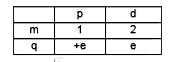
2

For circular path in magnetic field.
`r = (mv)/(qB) = (sqrt(2mE_(x))/(qB))`
So,

`r_(1) : r_(2) = sqrt(2) : 1`
Promotional Banner

Topper's Solved these Questions

  • JEE MAINS 2022

    JEE MAINS PREVIOUS YEAR|Exercise PHYSICS (SECTION -A)|20 Videos
  • JEE MAINS 2021

    JEE MAINS PREVIOUS YEAR|Exercise Physics (Section B )|10 Videos
  • JEE MAINS 2023 JAN ACTUAL PAPER

    JEE MAINS PREVIOUS YEAR|Exercise Question|360 Videos

Similar Questions

Explore conceptually related problems

A proton, a deuteron and an alpha - particle having the same kinetic energy are moving in circular trajectors in a constant magnetic field. If r_p, r_d and r_(alpha) denote respectively the radii of the trajectories of these particles then

A proton , a deutron and alpha ) - particle having the same kinetic energy are moving in circular trajectories in a constant magnetic field . If r_(p), r_(d) , and r_(alpha) denote respectively the radii of the trajectories of these particles , then

A proton, a deutron and alpha -particle, whose kinetic energies are same, enter perpendicularly a uniform magnetic field. Compare the radii of their circualr paths.

An electron, a proton and an alpha particle having the same kinetic energy are moving in circular orbits of radii r_(e),r_(p),r_(alpha) respectively in a uniform magnetic field B. The relation between r_(e),r_(p),r_(alpha) is:

Assertion: A proton an an alpha particle having the same kinetic energy are moving in circular paths in a unifrom magnetic field. The radii of their circular paths wll be equal. Reason: Any two charged particles having equal kinetic energies and entering a region of unifrom magnetic feild vec(B) in a direction perpendicular to vec(B) , will describe circular trajectoreis of equal radii.

Magnetic force acting on the charged particle projected perpendicular to magnetic field is proportional to r^(n) , where r is radius of circular path. Find n

A proton , a deuteron and an alpha -particle enter a magnetic field perpendicular to field with same velocity. What is the ratio of the radii of circular paths ?

