Home
Class 12
PHYSICS
A and B are two parallel sided transpare...

A and B are two parallel sided transparent slabs of refractive indices `n_(1) " and" n_(2)` respectively. A ray is incident at an angle `theta` on the surface of separation of A and B and after refraction from B into air grazes the surface of B. Then

A

`sin theta = (1)/(n_(2))`

B

`sin theta = (1)/(n_(1))`

C

`sin theta = (n_(2))/(n_(1))`

D

`sin theta = (n_(1))/(n_(2))`

Text Solution

Verified by Experts

The correct Answer is:
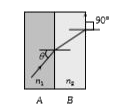
B

From Snell.s law 
`n_(1) sin theta = 1`
`sin theta = (1)/(n_(1))`
Promotional Banner

Similar Questions

Explore conceptually related problems

A,B, and C are the parallel sided transparent media of refractive indices n_(1),n_(2) and n_(3) respectively. They are arranged as shown in the figure. A ray is incident at an angle i on the surface of separation of A and B which is as shown in the figure. After the refraction into the medium B the ray grazes the surfaces of separation of the media B and C. then sin i equal to

A ray of light in air is incident at an angle of 45^(@) on the surface of separation of a medium. It is refracted in the medium at an angle of 30^(@) . What is the velocity of light in that medium ?

A equilateral glass prism has a refractive index sqrt (2) . A light ray is incident at 45^ @ on one face.Total deviation of ray after refraction from second surface is n times15^(0) where 'n' is

A ray of light is incident on the surface of a glass plate of index of refraction 1.55 at the polarizing angle. Calculate the angle of refraction.

A ray is incident on a slab of refractive index 5/4 at an angle /theta as shown. Find maximum angle /theta so that TIR occur at surface AD.

AN unpolarised beam of light is incident at the polarising angle on the surface of a transparent medium of refractive index 1.6. The angle of refraction in the medium is

A rectengular glass slab ABCD of refractive index n_1 is immersed in water of refractive index n_2(n_1gtn_2) . A ray of light is incident at the surface AB of the slab as shown. The maximum value of the angle of incidence alpha_max such that the ray comes out only from the other surface CD is given by

