Home
Class 12
PHYSICS
On a bright sunny day a diver of height ...

On a bright sunny day a diver of height h stands at the bottom of a lake of depth H. Looking upward, he can see objects outside the lake in a circular region of radius R. Beyond this circle he sees the image of objects lying on the floor of the lake. If refractive index of water is 4/3, then the value of R is–

A

`(3(H-h))/(sqrt(7))`

B

3h `sqrt(7)`

C

`(H-h)/(sqrt((7)/(3)))`

D

`((H-h))/(sqrt((5)/(3)))`

Text Solution

Verified by Experts

The correct Answer is:
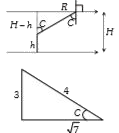
A

`n_(2) sin C = n_(1) sin 90`
`(4)/(3) sin C = 1 rArr sin C - (3)/(4) `
`tanC = (3)/(sqrt(7)) = (R )/(H - h)`
`R = (3)/(sqrt(7)) (H - h).`
Promotional Banner

Similar Questions

Explore conceptually related problems

A diver looking up through the water sees the outside world contained in a circular horizon. The refractive index of water is (4)/(3) , and the diver's eyes are 15 cm below the surface of 3 water. Then the radius of the circle is:

A fish looking up through the water sees the outside world contained in a circular horizon. If the refractive index of water is 4//3 and the fish is 12cm below the surface, the radius of this circle in cm is

A fish looking up through the water sees the outside world contained in a circular horizon. If the refractive index of water is (4)/(3) and the fish is 12 cm below the surface, the radius of this circle is cm is

A fish situated at a depth h below the surface of water in a lake ,can see the outside objects in air through a circular aperature of radius r . What is the radius of the aperture in terms of h and n ,where n = ""_(a) n_(w) ? [ ""_(a) n_(w) = R.I. of water w.r.t. air]

A luminous object O is located at the bottom of a big pool of liquid of refractive index mu and depth h. The object O emits rays upwards in all directions, so that a circle of light is formed at the surface of the liquid by the rays which are refracted into the air. what happens to the rays beyond the circle ? Determine the radius and the area of the circle .

An observer can see through a pin-hole the top end of a thin rod of height h, placed as shown in the figure. The beaker height is 3h and its radius h. When the beaker is filled with a liquid up to a height 2h, he can see the lower end of the rod. Then the refractive index of the liquid is

