Home
Class 11
CHEMISTRY
The first (Delta(i)H(1)) and second (Del...

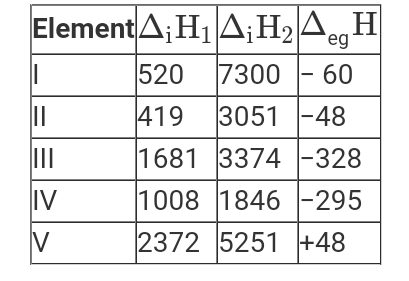
The first `(Delta_(i)H_(1))` and second `(Delta_(i)H_(2))` ionization enthalpies `("in kJ mol"^(-1))` and the electron gain enthalpy `(Delta_(eg)H)("in kJ mol"^(-1))` of the elements I, II, III, IV and V are given below

the least reactive non - metal and the most reactive metal of these are respectively

A

I and V

B

V and II

C

II and V

D

IV and V

Text Solution

Verified by Experts

The correct Answer is:

C

Element II : `Delta_iH_1` is lowest and there is sudden jump between the values of `Delta_iH_1 and Delta_i H_2` so its oxidation state is +1 and this element (metal) will be the most reactive metal.
Element V : The value of electron gain enthalpy `(Delta_(eg) H)` is positive. It means that energy is required to gain one electron.
Thus this non-metal will be the least reactive one.
Promotional Banner

Similar Questions

Explore conceptually related problems

The first (DeltaH_(1)) and second (DeltaH_(2)) ionisation enthalpies (in kJ mol^(-1)) and the (DeltaH_(eg)) electron gain enthalpy (in kJ mol^(-1)) of a elements are given below: Based on the above information match the following columns.

Ionisation enthalpy (Delta_(i)"H kJ mol"^(-1)) for the elements of group 13 follows the order.

Ionisation enthalpy (Delta_(t)H_(l) "in" kJ mol^(-1)) for the elements of group-13 follows the order

The first (Delta_(i)H_(1)) and second (Delta_(i)H_(2)) ionisation enthalpies ("in" kJ mol^(-1)) and the (Delta_(eg)H^(ө)) electron gain enthalpy ("in" kJ mol^(-1)) of a few elements are given below: {:("Elements",(Delta_(i)H_(1)),(Delta_(i)H_(2)),Delta_(eg)H^(ө)),(I,520,7300,-60),(II,419,3051,-48),(III,1681,3374,-328),(IV,1008,1846,-295),(V,2372,5251,+48),(VI,738,1451,-40):} Which of the above elements is likely to be a. the least reactive element. b. the most reactive metal. c. the most reactive non-metal. d. the least reactive non-metal. e. the metal which can form a stable binary halide of the formula MX (X=halogen). f. the metal which can form a predominantly stable covalent halide of the formula MX(X=halogen).

The second electron gain enthalpies (in kJ mol^(-1) ) of oxygen and sulphur respectively are:

Why do halogens have high electron gain enthalpies (i.e. -Delta_(eg)H^(o.)) ?
