Home
Class 12
CHEMISTRY
EMF of a cell is related to standard EMF...

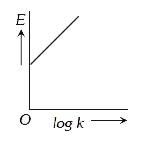
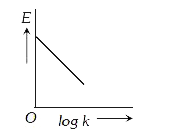
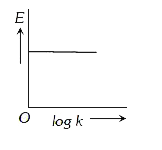
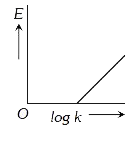
EMF of a cell is related to standard EMF,`E^(@)` by the equation
`E=E^(@)-(0.0591)/(n)logk`
Where k is reaction quotient and n the volume of electrons which is correct graphical representation

A

B

C

D

Text Solution

Verified by Experts

The correct Answer is:

B

Properties of ionic solid
Promotional Banner

Similar Questions

Explore conceptually related problems

The cell potential (E_(cell)) of a reaction is related as /_\G=-nF E_(cell) , where /_\ G represents max. useful electrical work n=no. of moles of electrons exchanged during the section for reversible cell reaction d(/_\G)=(/_\_rV)dp-(/_\_rS),dT at constant pressure d(/_\G)=-(/_\_rS).dT :' At constant pressure /_\G=/_\H-T./_\S :. /_\G=/+\H+T(d(/_\G))/((dT)_P) ((dE_(cell))/(dT))_P is known as temperture coefficient of the e.m.f of the cell. The temperature coefficient of the e.m.f of cell, ((dE)/(dT))_P si given by:

The standard electrode potentials at 298 K are given below: E_(Zn^(2+)| Zn )^(0) = -0.76 volt and , E_(Fe^(2+)|Fe)^(0) = -0.44 volt , E_(H^(2+)|H_(2))^(0) = -0.0volt Which of the two electrodes should be combined to form a cell having highest EMF? Identify the cathode and the anode and write the cell reaction. Also mention the direction of flow of electrons in the external as well as the internal circuit.

In an electrochemical cell, if E^(@) is the e.m.f. of the cell involving 'n' mole of electrons, then DeltaG^(@) is

A group of N cells where e.m.f. varies directly with the internal resistance as per the equation E_(N)=1.5r_(N) are connected as shown in the figure. The current I in the circuit is:

The driving force DeltaG diminishes to zero on the way to equilibrium, just as in any other spontaneous process. Both DeltaG and the corresponding cell potential (E=-(DeltaG)/(nF)) are zero when the redox reaction comes to equilibrium. The Nernst equation for the redox process of the cell may be given as : E=E^(@)-0.059/n log Q The key to the relationship is the standard cell potential E^(@) , derived from the standard free energy changes as : E^(@)=-(DeltaG^(@))/(nF) At equilibrium, the Nernst equation is given as : E^(@)=0.059/n log K The equilibrium constant K_(c) for the reaction : Cu(s)+2Ag^(+) (aq.)+2Ag(s)" "(E_(cell)^(@)=0.46 V) will be :
