Home
Class 12
CHEMISTRY
For the reaction A to Product k=(1)/(...

For the reaction `A to ` Product
`k=(1)/(t)[(1)/(a-x)-(1)/(a)]`
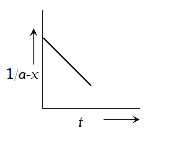
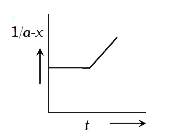
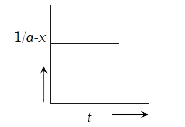
Where k is rate constant (in `mol^(-1)s^(-1)`) and `(a-x)` are the concentration of A at the start and after time interval t sec. A graph between `(1)/(a-x)` and time t is of the following

A

B

C

D

Text Solution

AI Generated Solution

The correct Answer is:

To solve the problem, we start with the given equation for the reaction: \[ k = \frac{1}{t} \left( \frac{1}{a-x} - \frac{1}{a} \right) \] Where: - \( k \) is the rate constant (in \( \text{mol}^{-1}\text{s}^{-1} \)), - \( a \) is the initial concentration of reactant A, - \( x \) is the amount of A that has reacted after time \( t \). ### Step 1: Rearranging the Equation We can rearrange the equation to express \( \frac{1}{a-x} \) in terms of \( t \): \[ kt = \frac{1}{a-x} - \frac{1}{a} \] Adding \( \frac{1}{a} \) to both sides gives: \[ \frac{1}{a-x} = kt + \frac{1}{a} \] ### Step 2: Identifying the Linear Form This equation can be compared to the linear equation \( y = mx + c \), where: - \( y = \frac{1}{a-x} \), - \( m = k \) (the slope), - \( x = t \) (the independent variable), - \( c = \frac{1}{a} \) (the y-intercept). ### Step 3: Analyzing the Graph From the rearranged equation, we can conclude: - The graph of \( \frac{1}{a-x} \) versus \( t \) is a straight line. - The slope of this line is positive since \( k \) is a positive rate constant. - The y-intercept is \( \frac{1}{a} \). ### Step 4: Evaluating the Options Now, we need to evaluate the given options for the graph: 1. A graph with a negative slope is incorrect because \( k \) is positive. 2. A graph with a zero slope is incorrect because \( k \) is not zero. 3. A graph with a positive slope and a y-intercept of \( \frac{1}{a} \) is correct. 4. A graph with a zero slope is again incorrect. Thus, the correct option is the one that shows a straight line with a positive slope and a y-intercept at \( \frac{1}{a} \). ### Conclusion The graph of \( \frac{1}{a-x} \) versus time \( t \) will be a straight line with a positive slope \( k \) and a y-intercept of \( \frac{1}{a} \).

To solve the problem, we start with the given equation for the reaction: \[ k = \frac{1}{t} \left( \frac{1}{a-x} - \frac{1}{a} \right) \] Where: - \( k \) is the rate constant (in \( \text{mol}^{-1}\text{s}^{-1} \)), - \( a \) is the initial concentration of reactant A, - \( x \) is the amount of A that has reacted after time \( t \). ...
Promotional Banner

Similar Questions

Explore conceptually related problems

[A] = reactant concentration at time 't', k = rate constant

Rate constant k=2.303 min^(-1) for a particular reaction. The initial concentration of the reactant is 1 mol // litre then rate of reaction after 1 minute is:

For a reation: A rarr Product, rate law is -(d[A])/(dt)=K[A]_(0) . The concentration of A left after time t when t=1/K is:

Rate constant k=2.303"min"^(-1) for a particular reaction. The initial concentration of the reaction is 1. mol/L, then rate of reaction after 1 minute is
