

Home
Class 12
CHEMISTRY
Consider the strong electrolytes Z(m)X(n...

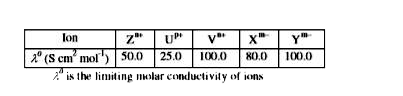
Consider the strong electrolytes `Z_(m)X_(n) ,U_(m)Y_(p) and V_(m)X_(n)`.Limiting molar conductivity `(Delta^(0))` of `U_(m)Y_(p) and V_(m)X_(n) `are 440 S `cm^(2) mol^(-1)` , respectively. The value of `(m+n+p)` is _______. Given :

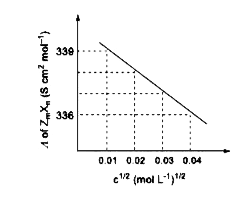
The plot of molar conductivity `(Delta)` of `Z_(m)X_(n) ` vs `c^(1//2)` is given below .

Promotional Banner

Topper's Solved these Questions

  • JEE ADVANCED 2022

    JEE ADVANCED PREVIOUS YEAR|Exercise CHEMISTRY (SECTION 2)|6 Videos
  • JEE ADVANCED 2022

    JEE ADVANCED PREVIOUS YEAR|Exercise CHEMISTRY (SECTION 3)|4 Videos
  • JEE ADVANCED 2021

    JEE ADVANCED PREVIOUS YEAR|Exercise QUESTION|38 Videos

Similar Questions

Explore conceptually related problems

m_(p) and m_(n) are masses of proton and neutron respectively. An element of mass M has Z protons and N neutrons then

m_(P) and m_(n) are masses of proton and neutron respectively. An element of mass m has Z protons and N neutrons, then

If x^(m)y^(n)=(x+y)^(m+n)

If m and n are the roots of the quadratic equation x^(2) + px + 8=0 with m- n = 2, then the value of p' is

If ((m+n) x -(a-b) )/((m-n)x -(a+b))=((m+n)x +a+c)/((m-n)x+a-c) then find the value of x.

If x^(m)y^(n)=(x+y)^(m+n) , prove that : (d^(2)y)/(dx^(2))=0 .

If x^(m)*y^(n)=(x+y)^(m+n) then (dy)/(dx) is: