Home
Class 12
PHYSICS
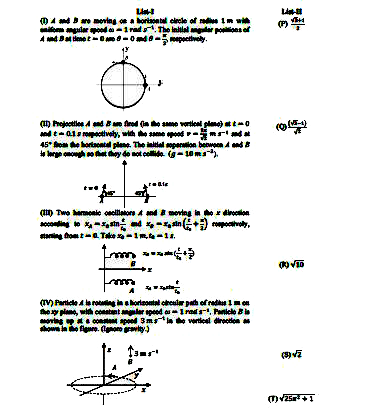
List I describes four systems, each with...

List I describes four systems, each with two particles A and B in relative motion as shown in figures. List II gives possible magnitudes of their relative velocities ( in` ms^(-1)` ) at time ` t = (pi )/(3)` S.

which one of the following options is correct ?

A

`I to R, II to P , III to Q , IV to S`

B

`I to S, II to P , III to Q , IV to R`

C

`I to S, II to T , III to P , IV to S`

D

`I to T, II to P , III to R , IV to S`

Text Solution

Verified by Experts

Promotional Banner

Topper's Solved these Questions

  • JEE ADVANCED 2022

    JEE ADVANCED PREVIOUS YEAR|Exercise PHYSICS (SECTION-2)|6 Videos
  • JEE ADVANCED 2021

    JEE ADVANCED PREVIOUS YEAR|Exercise QUESTION|38 Videos
  • MOCK TEST 2022

    JEE ADVANCED PREVIOUS YEAR|Exercise QUESTIONS|18 Videos

Similar Questions

Explore conceptually related problems

Two particles P and Q are projected simultaneously away from each other from a point A as shown in figure. The velocity of P relative to Q in ms^(-1) at the instant when the motion of P is horizontal is

There are two lists given below. List I has characteristics of teeth of different animals and List II has name of animals. Which one of the following options matched List I to List II correctly ?

A circular disc of radius R is rotating about its axis O with a uniform angular velocity omega"rad s"^(-1) as shown in the figure. The magnitude of the relative velocity of point A relative to point B on the disc is

Shown in the figure are the velocity time graphs of the two particles P_1 and P_2 . Which of the following statements about their relative motion is true ? Theire relative velocity

There are two lists given below. List I has food component and List II has source of food component. Which one of the following options matched list I to list II correctly ?

The velocity - time graph of a particle moving along X- axis is shown in the figure below. Match the entries of List with entries of List II V С В, D A t E

The velocity-time graph of a particle in one-dimensional motion is shown in the figure. Which of the following formulae is correct for describing the motion of the particle over the time interval t_1 to t_2 ?

