

Home
Class 10
MATHS
Prove that If a line is drawn parallel t...

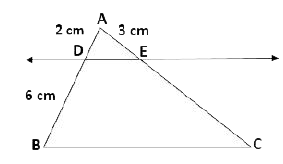
Prove that If a line is drawn parallel to one side of a triangle to intersect the other two sides in distinct points, the other two sides are divided in the same ratio. In the figure, find EC if `(AD)/(DB) = (AE)/(EC)` using the above theorem.

Promotional Banner

Topper's Solved these Questions

  • SAMPLE PAPER 2023 TERM I

    CBSE MODEL PAPER|Exercise Section E|12 Videos
  • SAMPLE PAPER 2023 TERM I

    CBSE MODEL PAPER|Exercise SECTION-A|20 Videos
  • SAMPLE PAPER 2023 TERM I

    CBSE MODEL PAPER|Exercise Section C|8 Videos
  • SAMPLE PAPER 2022 TERM II

    CBSE MODEL PAPER|Exercise SECTION C|10 Videos
  • SAMPLE PAPER 2024

    CBSE MODEL PAPER|Exercise Question|94 Videos

Similar Questions

Explore conceptually related problems

Theorem 6.1 : If a line is drawn parallel to one side of a triangle to intersect the other two sides in distinct points, the other two sides are divided in the same ratio.

'If a line is drawn to one side of a triangle to intersect the other two sides in distinct points, prove that the other two sides are divided in the same ratio.

If a line is drawn parallel to one side of a triangle to intersect the other two sides in disinct points, the other two sides are divided in the same ratio. Using this theoure. Find EC in if DE||BC.

Prove that, if a line is drawn parallel to one side of a triangle to intersect the other two sides in distinct points, the other two sides are divided in the same ratio. Using the above result, do the following: In Fig. 7 .45 DE abs() BC and BD = CE. Prove that DeltaABC is an isosceles triangle.

Prove that , "If a line parallel to a side of a triangle intersects the remaining sides in two distinct points then the line divides the sides in the same proportion".

Basic proportionality Theorem or Thales Theorem - If a line is drawn parallel to one side of a triangle intersecting the other two sides; then it divides the two sides in the same ratio.

If a line is drawn parallel to the base of an isosceles triangle to intersect its equal sides, prove that the quadrilateral, so formed is cyclic.

The line drawn from the midpoint of one side of a triangle parallel to another side bisects the third side.