

Home
Class 12
PHYSICS
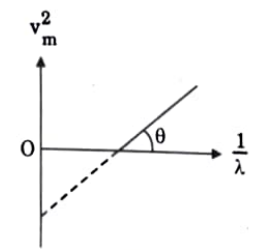
The figure shows vm^2 versus 1/lambda ra...

The figure shows `v_m^2` versus `1/lambda` raph for photoelectrons emitted from a surface where `v_m` is the maximum speed of electrons and `lambda` is the wavelength of incident radiation. Using this graph and Einstein's photoelectric equation, obtain the expression for Planck's constant andwork function of the surface.

Promotional Banner

Topper's Solved these Questions

  • QUESTION PAPER 2022 TERM 1 SET 2

    XII BOARDS PREVIOUS YEAR|Exercise SECTION C|6 Videos
  • SAMPLE PAPER 2019

    XII BOARDS PREVIOUS YEAR|Exercise SECTION D|6 Videos

Similar Questions

Explore conceptually related problems

The photoelectric work function of a surface is 2.2 eV. The maximum kinetic energy of photoelectrons emitted when light of wavelength 6200 Å is incident on the surface, is

The kinetic energy of the most energetic photoelectrons emitted from a metal surface is doubled when the wavelength of the incident radiation is reduced from lamda_1 " to " lamda_2 The work function of the metal is

The maximum velocity of an electron emitted by light of wavelength lambda incident on the surface of a metal of work function phi , is Where h = Planck's constant , m = mass of electron and c = speed of light.

The maximum kinetic energy of photoelectron is doubled when the wavelength of light incident on the photosensitive changes from lambda_1 to lambda_2 . Deduce expression for the threshold wavelength and work function for metals in terms of lambda_1 and lambda_2

Maximum kinetic energy of photoelectrons emitted from a metal surface, when light of wavelength lambda is incident on it, is 1 eV. When a light of wavelength lambda/3 is incident on the surfaces, maximum kinetic energy becomes 4 times. The work function of the metal is

Photoelectrons ar ejected from a surface when light of wavelenght lamda_1=550 nm is incident on it. The stopping potential for such electrons is lamda_(S1)=0.19V . Suppose that radiation of wavelength lamda_2=190nm is incident of the surface. Q. Calulate the work function of the surface.

The stopping potential for photoelectrons emitted from a surface illuminated by light wavelength of 5893A is 036 V . Calculate the maximum kinetic energy of photoelectrons, the work function of the surface, and the threshold frequency.

The velocity of the most energetic electrons emitted from a metallic surface is doubled when the frequecy v of incident radiation is double. The work function of this metal is

When a high frequency electromagnetic radiation is incident on a metallic surface, electrons are emitted from the surface. Energy of emitted photoelectrons depends only on the frequency of incident electromagnetic radiation and the number of emitted electrons depends only on the intensity of incident light. Einstein's protoelectron equation [K_(max)=hv-phi} correctly ecplains the PE, where upsilon= frequency of incident light and phi= work function. Q. The slope of the graph shown if Fig. [here h is the Planck's constant and e is the charge of an electron] is

A photon sensitive metallic surface emits electrons when X-rays of wavelength lambda fal on it. The de-Broglie wavelength of the emitted electrons is (Neglect the work function of the surface, m is mass of the electron. H=Planck's constant. C= velocity of light)

XII BOARDS PREVIOUS YEAR-QUESTION PAPER 2023-Question
  1. Assertion (A): When three electric bulbs of power 200 W, 100 W and 50 ...

    Text Solution

    |

  2. Assertion (A): A current carrying square loop made of a wire of length...

    Text Solution

    |

  3. The figure shows vm^2 versus 1/lambda raph for photoelectrons emitted ...

    Text Solution

    |

  4. Describe the process by which energy is released by the sun.

    Text Solution

    |

  5. Using Gauss’ law, derive an expression for the electric field at a poi...

    Text Solution

    |

  6. .A cell of emf E and internal resistance r is connected across a varia...

    Text Solution

    |

  7. Obtain an expression for electrostatic potential energy ofa system of ...

    Text Solution

    |

  8. Two small conducting balls A and B of radius r1 and r2 have charges q1...

    Text Solution

    |

  9. What is a displacement current ? How is it different from a conduction...

    Text Solution

    |

  10. Write any two characteristics of an electromagnetic wave. Why are micr...

    Text Solution

    |

  11. (a) Draw a plot showing the variation of potential energy of a pair of...

    Text Solution

    |

  12. A current carrying circular loop and a straigbt wire bent partly in th...

    Text Solution

    |

  13. (i) In diffraction due to a single slit, the phase difference between ...

    Text Solution

    |

  14. (i)In a Young's double-slit experiment SS2-SS1=lambda/4,where S1 and S...

    Text Solution

    |

  15. A resistor of 30 ohm and a capacitor of 250/pi muF are connected in se...

    Text Solution

    |

  16. A Series LCR circuit with R = 20 ohm,L=2H and C=50muF is connected to ...

    Text Solution

    |

  17. A rectangular conductor MNPQ with a movable arm MN (resistance r) is k...

    Text Solution

    |

  18. (i) Define mobility of electrons. Give its SI units. (ii) A steady cur...

    Text Solution

    |

  19. (i) Define electrical conductivity of a wire. Give its SI unit. (ii) H...

    Text Solution

    |

  20. (i) Explain the working principle of an optical fibre with the help of...

    Text Solution

    |