

Home
Class 11
PHYSICS
A particle of mass m is attached to thre...

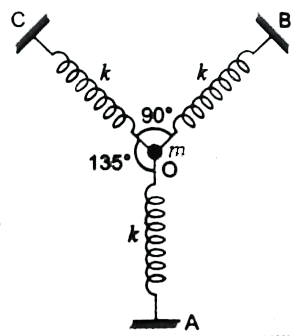
A particle of mass `m` is attached to three identical springs of spring constant `k` as shwon in figure. The time period of vertical oscillation of the particle is

Promotional Banner

Similar Questions

Explore conceptually related problems

A particle of mass m is attached to three identical massless springs of spring constant 'k' as shown in the figure. The time period of vertical oscillation of the particle is

A particle of mass 'm' is attached to three identical springs A,B and C each of force constant 'K' as shown in figure. If the particle of mass 'm' is pushed slightly against the spring 'A' and released the period of oscillations is

A particle of mass 'm' is attached to three identical springs A,B and C each of force constant 'K' as shown in figure. If the particle of mass 'm' is pushed slightly against the spring 'A' and released the period of oscillations is

A particle of mass 'm' is attached to three identical springs A,B and C each of force constant 'K' as shown in figure. If the particle of mass 'm' is pushed slightly against the spring 'A' and released the period of oscillations is

The following figure shows a particle of mass, m , attached with four identical springs, each of length l . Initial tension in each spring is F_(0) . The period of small oscillations of the particle along a line perpendicular to the plane of the figure is (neglect gravity)

A particle of mass m is attached to three springs A,B and C of equal force constants k as shown in figure. If the particle is pushed slightly against the spring C and released, find the time period of oscillation.

A particle of mass m is attached to three springs A,B and C of equal force constants k as shown in figure. If the particle is pushed slightly against the spring C and released, find the time period of oscillation.