

Home
Class 12
PHYSICS
ABCD is a square where each side is a un...


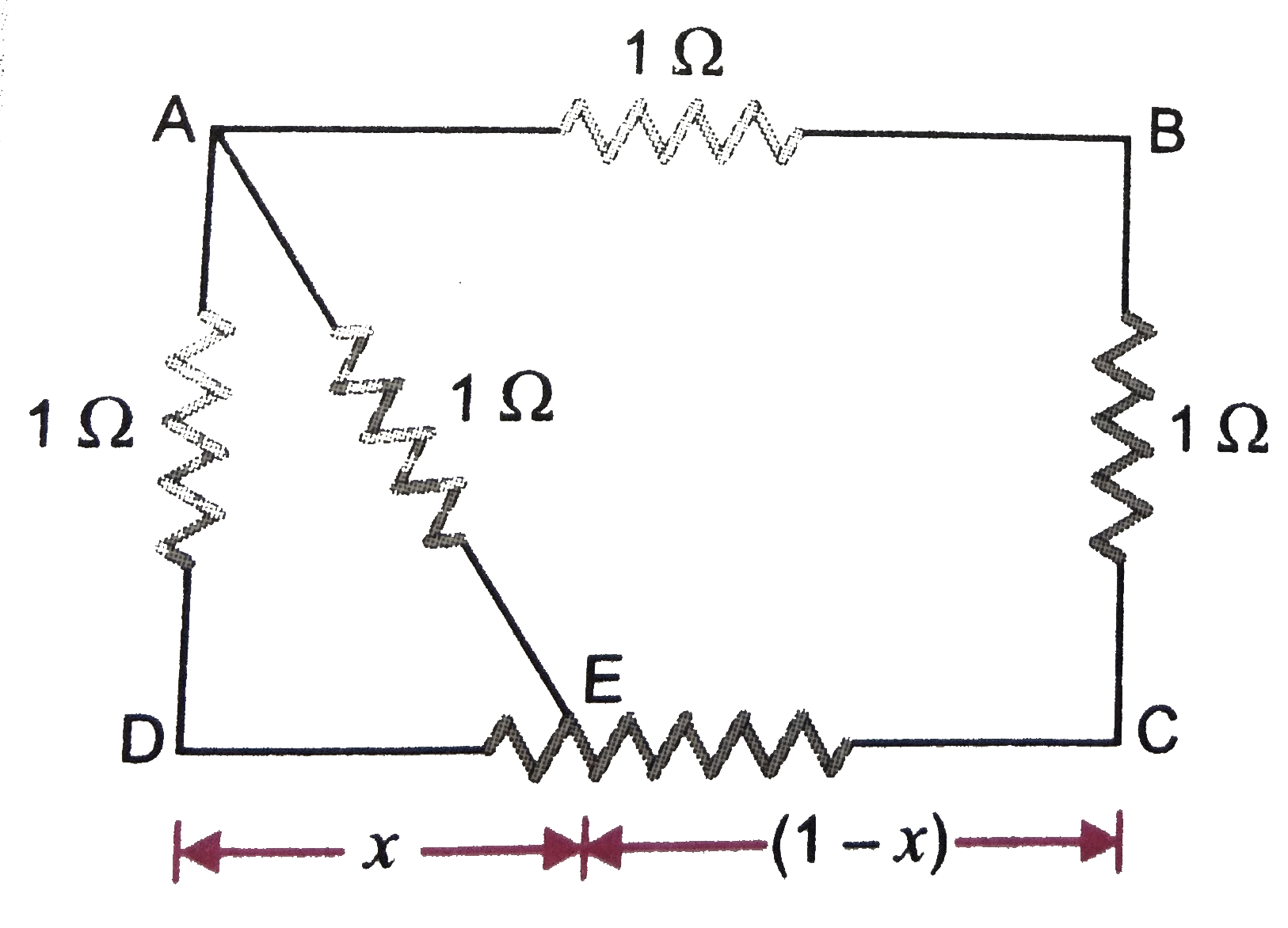
ABCD is a square where each side is a uniform wire of resistance `1 Omega`. Find a point E on CD such that if a uniform wire of resistance `1 Omega` is connected across AE and a constant potential is applied across A and C, the points B and E will be equipotential.

Promotional Banner

Similar Questions

Explore conceptually related problems

In figure. ABCD is a square where side is a uniform wire of resistance 1Omega . Find the a point E on CD such that if a uniform wire of resistance 1Omega is connected across AE and a constant potential differene is applied across A and C the points B and E are equipotential.

ABCD is a square where each side is a uniform wire of resistance 1Omega. A point E lies on CD such that if a uniform wire of resistance 1Omega is connected across AE and constant potential difference is applied across A and C, then B and E are equipotential.

ABCD is a square where each side is a uniform wire of resistance 1Omega. A point E lies on CD such that if a uniform wire of resistance 1Omega is connected across AE and constant potential difference is applied across A and C, then B and E are equipotential.

A uniform wire of resistance 18 Omega is bent in the form of a circle. The effective resistance across the points a and b is

A uniform wire of resistance 36 Omega is bent in the form of a circle. The effective resistance across the points A and B is

A uniform wire of resistance 18 Omega is bent in the form of a circle. The effective resistance across the points a and b is

A uniform wire of resistance 36 Omega is bent in the form of a circle. The effective resistance across the points A and B is

AB is a uniform wire of resistance 2000 Omega and C is the midpoint of AB. A voltmeter of resistance 1000 Omega is connected between A and B. Then the reading of the voltmeter, when the p.d. is applied across AB is 150 V, is

If a wire of resistance 20 Omega is covered with ice and a voltage of 210 V is applied across the wire , then the rate of melting of ice is

If a wire of resistance 20 Omega is covered with ice and a voltage of 210 V is applied across the wire , then the rate of melting of ice is