

Home
Class 11
PHYSICS
Figure shows the variation in temperatur...

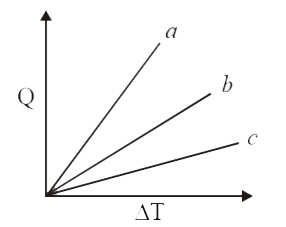
Figure shows the variation in temperature (DT) with the amount of heat supplied (Q) in an isobaric process corresponding to a monoatomic (M), diatomic (D) and a polyatomic (P) gas. The initial state of all the gases are the same and the scales for the two axes coincide. Ignoring vibrational degrees of freedom, the lines a, b and c respectively correspond to

Promotional Banner

Similar Questions

Explore conceptually related problems

Figure shows an isochore, an isotherm, an adiabatic and two isobars of two gases on a work done versus heat supplied curve. The initial states of both gases are the same and the scales for the two axes are same.

Figure shows an isochore, an isotherm, an adiabatic and two isobars of two gases on a work done versus heat supplied curve. The initial states of both gases are the same and the scales for the two axes are same.

The straight lines in the figure depict the variations in temperature DeltaT as a function of the amount of heat supplied Q is different process involving the change of state of a monoatomic and a diatomic ideal gas . The initial states, ( P,V,T ) of the two gases are the same . Match the processes as described, with the straight lines in the graph as numbered. {:(,"Column-I",,"Column-II"),((A),"Isobaric process of monoatomic gas." ,(p),"1" ),((B),"Isobaric process of diatomic gas" ,(q),"2" ),((C),"Isochoric process of monoatomic gas" ,(r),"Minimum at section B"), ((D),"Isochoric process of diatomic gas" ,(s),"x-axis (i.e.'Q' axis)"):}

The straight lines in the figure depict the variations in temperature DeltaT as a function of the amount of heat supplied Q is different process involving the change of state of a monoatomic and a diatomic ideal gas . The initial states, ( P,V,T ) of the two gases are the same . Match the processes as described, with the straight lines in the graph as numbered. {:(,"Column-I",,"Column-II"),((A),"Isobaric process of monoatomic gas." ,(p),"1" ),((B),"Isobaric process of diatomic gas" ,(q),"2" ),((C),"Isochoric process of monoatomic gas" ,(r),"Minimum at section B"), ((D),"Isochoric process of diatomic gas" ,(s),"x-axis (i.e.'Q' axis)"):}

The straight lines in the figure depict the variations in temperature DeltaT as a function of the amount of heat supplied Q is different process involving the change of state of a monoatomic and a diatomic ideal gas . The initial states, ( P,V,T ) of the two gases are the same . Match the processes as described, with the straight lines in the graph as numbered. {:(,"Column-I",,"Column-II"),((A),"Isobaric process of monoatomic gas." ,(p),"1" ),((B),"Isobaric process of diatomic gas" ,(q),"2" ),((C),"Isochoric process of monoatomic gas" ,(r),"Minimum at section B"), ((D),"Isochoric process of diatomic gas" ,(s),"x-axis (i.e.'Q' axis)"):}

The amount of heat supplied to an ideal gas is laid off on the horizontal axis and the amount of work performed by the g-as is laid off on the vertical axis. One of the straight lines in the ligure is an isotherm and the other two are isobars of two gases. The initial states of hoth gases (pressure, temperature, volume) are the same, and the scales on the two axes coincide. Which straight line corresponds to which process? How many degrees of freedom does each gas have? (Vibrational degrees of freedom are not to be taken into account.) The graphs of what processes coincide with the coordinate axes?

Figure shows the variation of internal energy (U) with the pressure (P) of 2.0 mole gas in cyclic process abcda.The temperature of gas at c and d are 300 and 500 K respectively. The heat absorbed by the gas during the process is Xxx 10 R ln 2 . Find the value of x.

Figure shows the variation of internal energy (U) with the pressure (P) of 2.0 mole gas in cyclic process abcda.The temperature of gas at c and d are 300 and 500 K respectively. The heat absorbed by the gas during the process is Xxx 10 R ln 2 . Find the value of x.