

Home
Class 11
PHYSICS
The p-T graph for the given mass of an i...

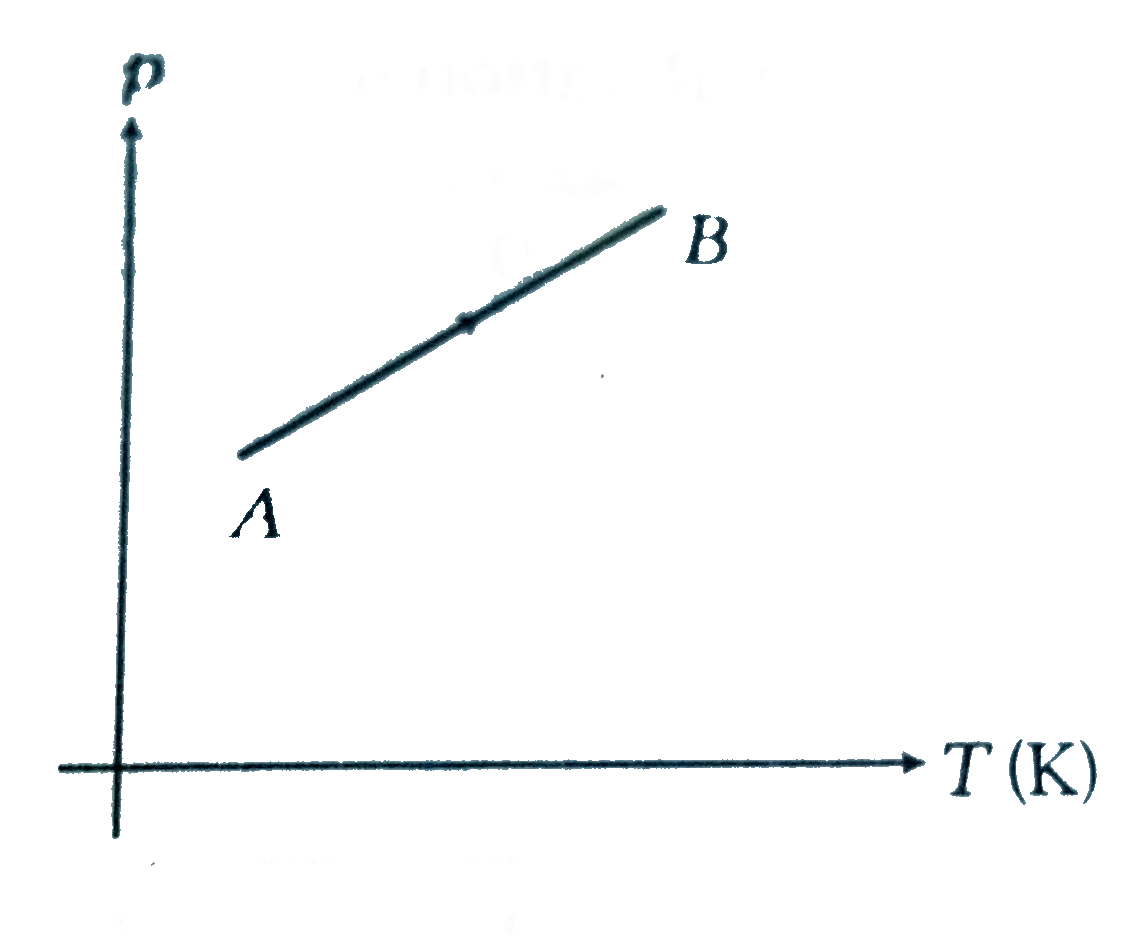
The `p-T` graph for the given mass of an ideal gas is shown in figure. What inferencfe can be drawn regarding the change in bolume (whtherit is constant, increasing or decreasing) ?

Promotional Banner

Similar Questions

Explore conceptually related problems

The p-T graph for the given mass of an ideal gas is shown in figure. What inference can be drawn regarding the change in Volume (whtherit is constant, increasing or decreasing) ?

The p-T graph for the given mass of an ideal gas is shown in figure. What inference can be drawn regarding the change in Volume (whtherit is constant, increasing or decreasing) ?

The p-T graph for the given mass of an ideal gas is shown in figure. What inference can be drawn regarding the change in volume (whether it is constant, increasing or decreasing) ? How to proceed Definitely, it is not constant. Because when volume of the gas is constant p-T graph is a straight line passing through origin. The given line does not pass through origin, hence volume is not constant. . V = (nR)((T)/P) Now, to see volume of the gas we will have to see whether (T)/(P) is increasing or decreasing.

The P-T graph for the given mass of an ideal gas is shown in figure. Then the volume

The P-T graph for the given mass of an ideal gas is shown in figure. Then the volume

The graph of pressure and temperature for an ideal gas is as shown in figure. The given process is

V-T graph of a process of monoatomic ideal gas is shown in figure. Change in internal energy of the gas is zero in process(s)-

V-T diagram for a process of given mass of ideal gas is as shown in fig. During the process pressure of the gas

V-T graph of a process of monoatomic ideal gas is shown in figure. Heat is supplied to the gas in process(s)-

Volume versus temperature graphs for a given mass of an ideal gas are shown in figure. At two different values of constant pressure. What can be inferred about relation between P_(1) and P_(2) ?