

Home
Class 11
PHYSICS
The horizontal bottom of a wide vessel w...

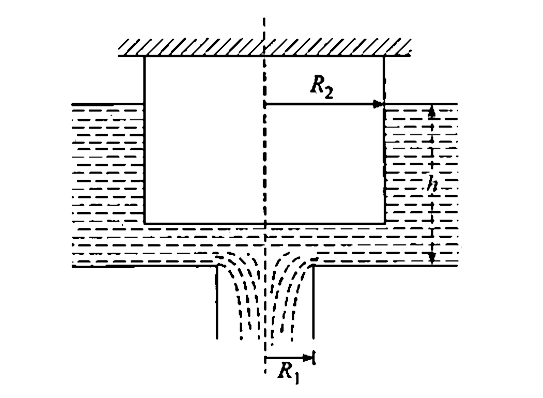
The horizontal bottom of a wide vessel with an ideal fluid has a round orifice of radius `R_(1)` over which a round closed cylinder is mounted, whose radius `R_(2) gt R_(1)`figure. The clearance between the cylinder and the bottom of the vessel is very small, the fluid density is `rho`. find the static pressure of the fluid in the clearance as a function of the distance r from the axis of the orifice (and the cylinder) , if the height of the fluid is equal to h.

Promotional Banner

Similar Questions

Explore conceptually related problems

The horizontal bottom of wide vessel with an ideal fluid has a round orifice of radius R_1 over which a round closed cylinder is mounted, whose radius R_2gtR_1 (figure). The clearance between the cylinder and the bottom of the vessel is very small, the fluid density is rho . Find the static pressure of the fluid in the clearance as a function of the distance r from the axis of the orifice (and the cylinder), if the height of the fluid is equal to h.

A long cylinder of radius R_1 is displaced along its axis with a constant velocity v_0 inside a stationary co-axial cylinder of radius R_2 . The space between the cylinders is filled with viscous liquid. Find the velocity of the liquid as a function of the distance r from the axis of the cylinders. The flow is laminar.

A hemispherical portion of a radius R is removed from the bottom of a cylinder of radius R. The volume of the remaining cylinder is V and its mass is M. It is suspended by a string in a liquid of density rho where it stays vertical . The upper surface of the cylinder is at a depth of h below the liquid surface. THe force on the bottom of the cylinder by the liquid is

A conical portion of radius R and height H is removed from the bottom of a cylinder of radius R. The volume of the remaining cylinder is V and its mass is M. It is suspended by a string in a liquid of density rho where it stays vertical . The upper surface of the cylinder is at depth h below the liquid surface . The force on the bottom of the cylinder by the liquid is

A hemispherical portion of radius R is removed from the bottom of a cylinder of radius R. The volume of the remaining cylinder is V and its mass M. It is suspended by a string in a liquid of density rho where it stays vertical. The upper surface of the cylinder is at a depth h below the liquid surface. The force on the bottom of the cylinder by the liquid is

A conical portion of radius R and height H is removed from the bottom of a cylinder of radius R. The volume of the remaining cylinder is V and its mass is M. It is suspended by a string in a liquid of density rho where it stays vertical . The upper surface of the cylinder is at depth h below the liquid surface . The force on the bottom of the cylinder by the liquid is

A hemispherical portion of radius R is removed from the bottom of a cylinder of radius R. The volume of the remaining cylinder is V and its mass M. It is suspended by a string in a liquid of density rho where it stays vertical. The upper surface of the cylinder is at a depth h below the liquid surface. The force on the bottom of the cylinder by the liquid is

A cylindrical vessel of radius r is filled with a homogeneous liquid upto a height h. It is found that the force exerted by the liquid column on the bottom of the cylinder is equal to the force exerted by the liquid on the sides of the cylinder. What is the relation between r and h?

In the bottom of a vessel with mercury of density rho there is a round hole of radius r. At what maximum height of the mercury layer will the liquid still not flow out through this hole. (Surface tension = T)–