

Home
Class 11
PHYSICS
The optical density of turpentine is hig...

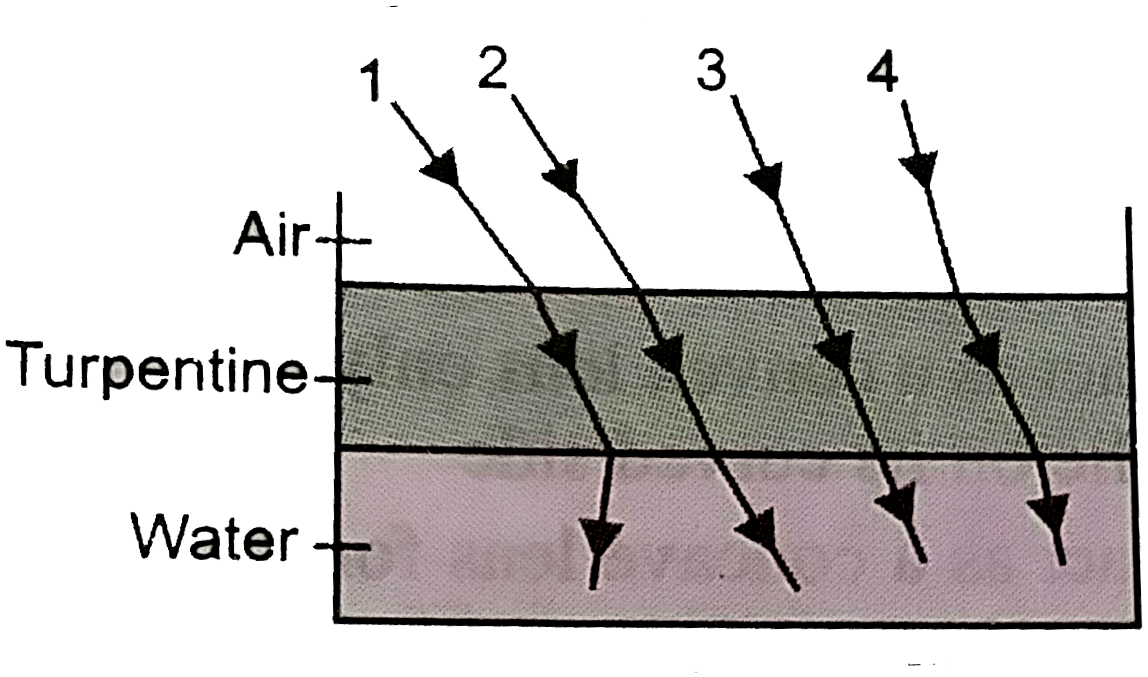
The optical density of turpentine is higher than that of water, while its mass density is lower. Fig. shows a layer of turpentine floating over water in a container. For which one of the four rays incident on turpentine in Fig., the path shows is correct ?
.

Promotional Banner

Similar Questions

Explore conceptually related problems

The optical density of turpentine is higher than that of water while its mass density is lower. Figure shows a layer of turpentine floating over water in a container. For which one of the four rays incident on turpentine in as figure, the path shown is correct?

The optical denstiy of turpentine is higher than that of water while its mass density is lower. Fig. EP. 9.9 shows a layer of turpentine floating over than that of water in a container. For which one of the four rays incident on turpentine in Fig. EP. 9.15 the path shown is correct?

Oil floats on water. This shows that density of oil is greater than the density of water. (T or F)

A solid sphere of density eta (gt 1) times lighter than water is suspended in a water tank by a string tied to its base as shown in fig. if the mass of the sphere is m then the tension in the string is given by

The Fig. shows a glass tumbler containing hot milk which is placed in a tub of cold water. State the direction in which heat will flow.

A water body characterized by nutrient rich water supports abundant growth of phytoplanktons and other water plants on its surface. Over time, the water body gets filled with a large number of such plants and the process is called Eutrophication. In such water bodies, dissolved oxygen content is nil or very less. A portion of a river is covered with a green layer of tiny floating organisms L on its surface and the pond water also contains organisms like tadpole, small fish, Alligator. Which of the following is the correct food chain for the above organisms?

A cylindrical body floats in water such that one-fourth of its volume lies above the surface of water. Find the density of the meterial with which the body is made of.