

Home
Class 11
PHYSICS
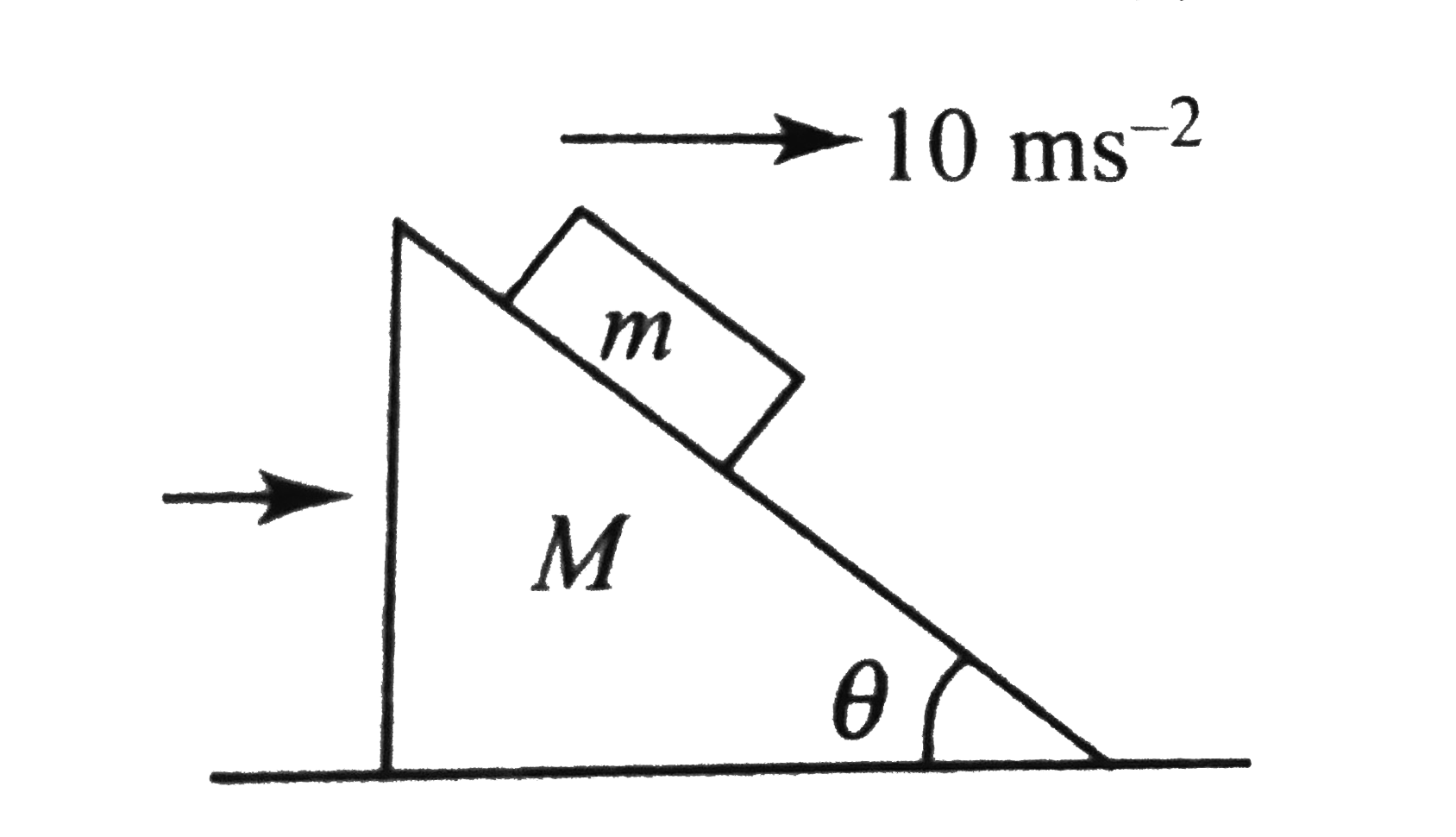
In figuer, shown all the surfaces are fr...

In figuer, shown all the surfaces are frictionless, and mass of the block is `m=100g`. The block and the wedge are held initially at rest. Now the wedge is given a horizontal acceleration of `10ms^-2` by applying a force on the wedge, so that the block does not slip on the wedge. Then find the work done in joules by the normal force in ground frame on the block in `1s`.

Promotional Banner

Similar Questions

Explore conceptually related problems

In the figure shown all the surfaces are frictionless, and mass of the block 'm' is 1 kg. The block and wedge are held initially at rest. Now wedge is given a horizontal acceleration of 5 m/s^(2) by applying a force on the wedge, so that the block does not slip on the wedge. Then work done by the normal force in ground frame on the block in 2 sec is : (##NAR_NEET_PHY_XI_P2_C06_E09_012_Q01.png" width="80%">

In the figure shown all the surfaces are frictionless and mass of block m=1kg , block and wedge are held initially at rest, now wedge is given a horizontal acceleration of 10 m//s^(2) by applying a force on the wedge so that the block does not slip on the wedge, the work done by normal force in ground frame on the block in sqrt(3) sec is .

In the figure shown all the surfaces are frictionless and mass of block m=1kg , block and wedge are held initially at rest, now wedge is given a horizontal acceleration of 10 m//s^(2) by applying a force on the wedge so that the block does not slip on the wedge, the work done by normal force in ground frame on the block in sqrt(3) sec is .

A horizontal force F pushes wedge of mass M on a smooth horizontal surface. A block of mass m is stationary to the wedge, then:

A block of mass 1.0 kg rests on a wedge of angle theta . The acceleration which should be given to the wedge so that the block falls freely is :

A block of mass 1.0 kg rests on a wedge of angle theta . The acceleration which should be given to the wedge so that the block falls freely is :

A block of mass m is placed on a smooth wedge of wedge angle theta The whole system is accelerated horizontally so that the block does not slip on the wedge. The force (normal reaction) exerted by the wedge on the block has a magnitude:

A block of mass m is placed on a smooth wedge of inclination theta . The whole system is accelerated horizontally, so that the block does not slip on the wedge. The force exerted by the wedge on the block (g is acceleration due to gravity) will be

A block of mass m is placed on a smooth wedge of inclination theta . The whole system is accelerated horizontally, so that the block does not slip on the wedge. The force exerted by the wedge on the block (g is acceleration due to gravity) will be

A block of mass m is placed on a smooth wedge of inclination theta . The whole system is accelerated horizontally, so that the block does not slip on the wedge. The force exerted by the wedge on the block (g is acceleration due to gravity) will be