

Home
Class 12
CHEMISTRY
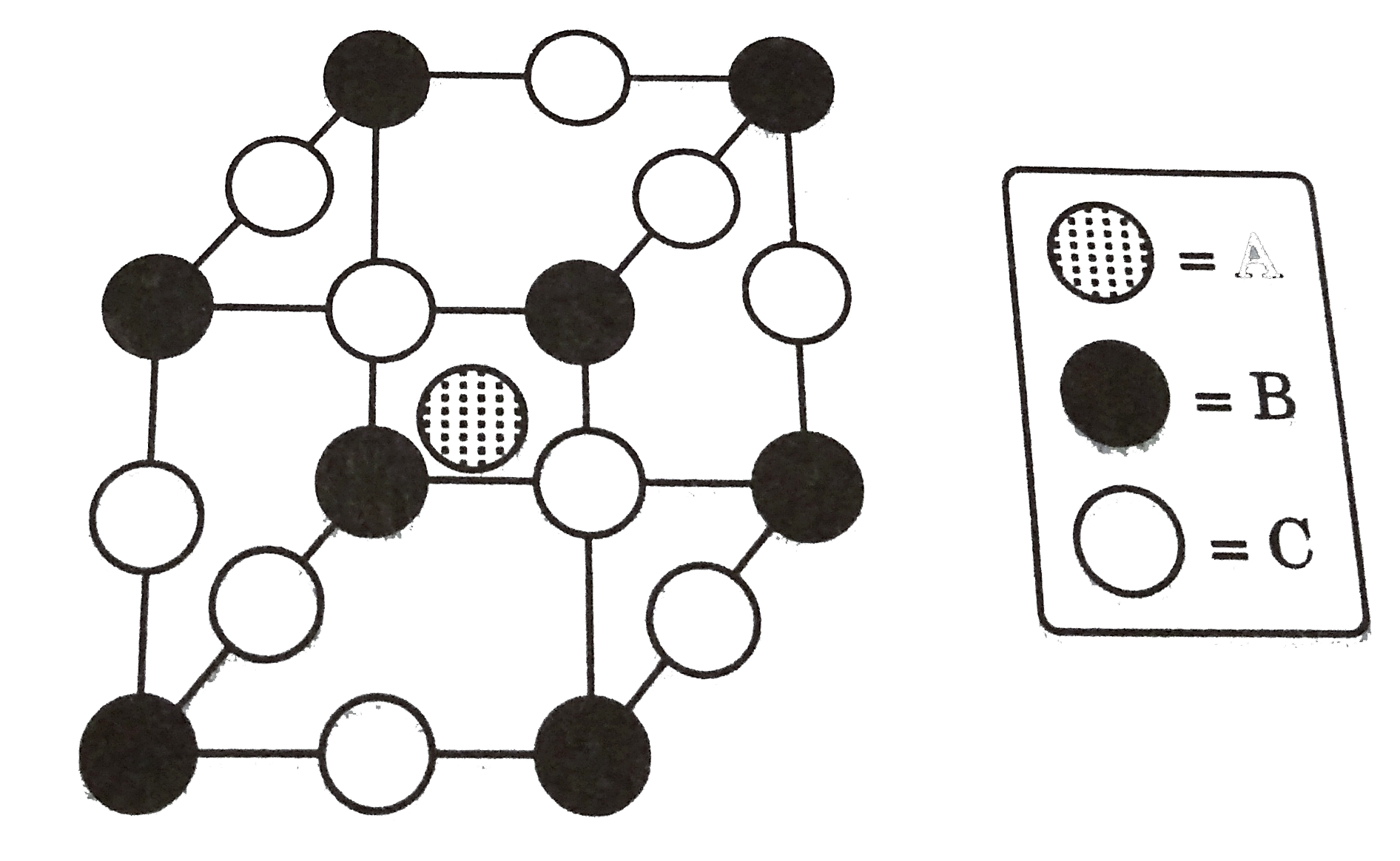
The cubic unit cell of a perovakite stru...

The cubic unit cell of a perovakite structure containing atoms of types A, B and C is illustrated below. What is the empirical formula of this substance?

Promotional Banner

Similar Questions

Explore conceptually related problems

The unit cell of a substance has cations A^(+) at the corners of the unit cell and anions B^(-) in the centre. What is the simplest formula of the substance ?

The unit cell of a substance has cations A^(+) at the corners of the unit cell and anions B^(-) in the centre. What is the simplest formula of the substance ?

The unit cell of a substance has cations A^(+) at the corners of the unit cell and anions B^(-) in the centre. What is the simplest formula of the substance ?

A face-centered cubic unit cell contains 8 ‘X’ atoms at the corners of the cell and 6 ‘Y’ atoms at the faces. If the empirical formula of the solid is X_(a)Y_(b) then, what is (b)/(a) ?

A face-centered cubic unit cell contains 8 ‘X’ atoms at the corners of the cell and 6 ‘Y’ atoms at the faces. If the empirical formula of the solid is X_(a)Y_(b) then, what is (b)/(a) ?

A solid compound contains XYZ atoms in a cubic lattice with X atoms occupying the corners, Y atoms in the body centred positions and Z atoms at the centres of faces of the unit cell. What is the empirical formula of the compound

In a cubic type unit cell, atoms of A are at centre and corners of the cube. Atoms of B are at one half faces of the cube. What is the simplest formula of the compound?

A cubic unit cell contains manganese ions at the corners and fluoride ions at the centre of each face. (a) What is the empirical formula ? (b) What is the C.N. of Mn^(2+) ion ? (c) Calculate the edge length of the unit cell if the radius of Mn^(2+) ion is 0.65Å and that of F^(-) ion is 1.36Å .