

Home
Class 11
PHYSICS
Two block tied with a massless string of...

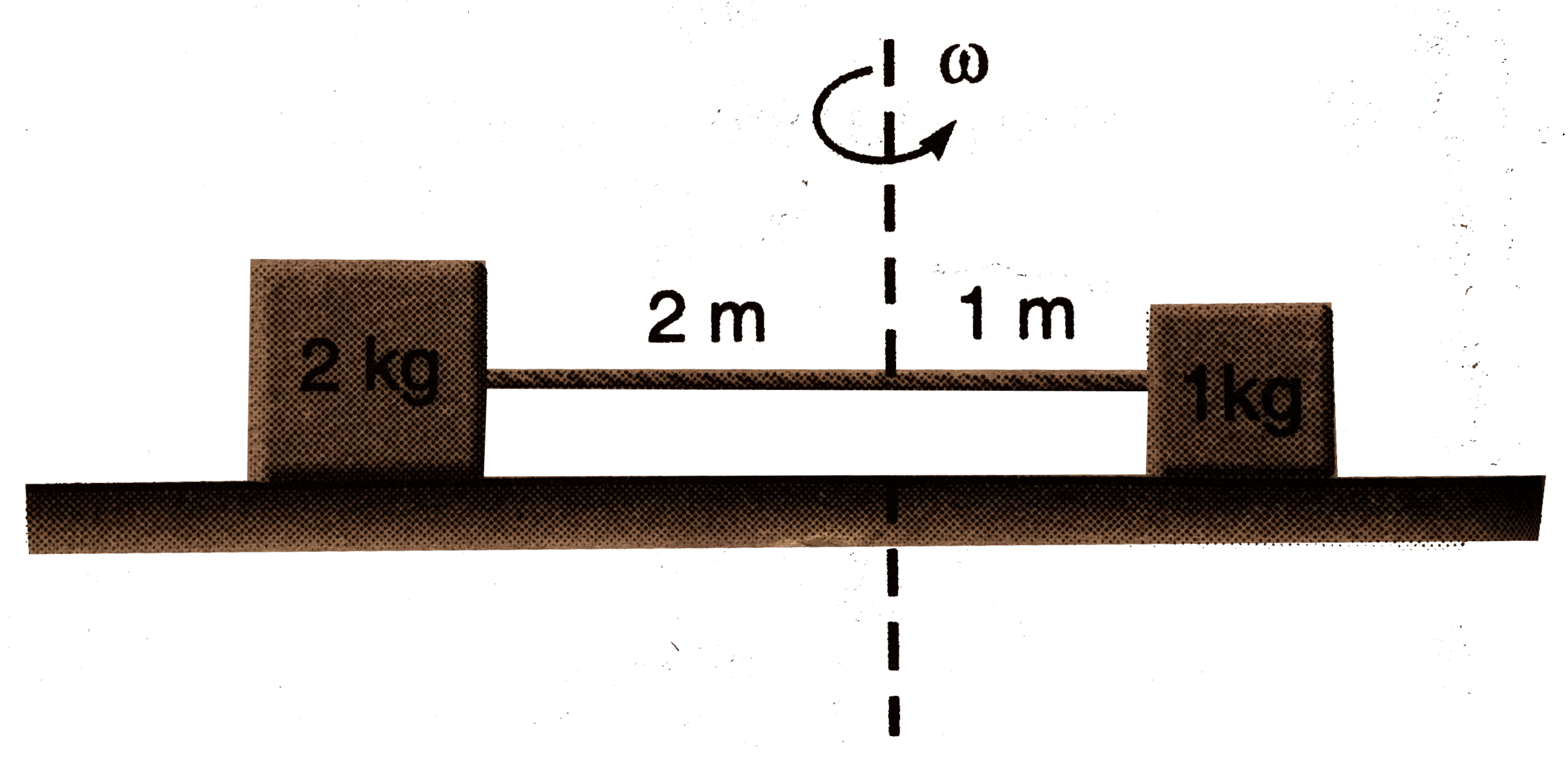
Two block tied with a massless string of length `3m` are placed on a rotating table as shown. The axis of rotation is `1m` from `1kg` mass and `2m` from `2kg` mass. The angular speed
`omega=4rad//s` . Ground below `2kg` block is smooth and below `1kg` block is rough. `(g=10m//s^(2))`
(a) Find tension in the string, force of friction on `1kg` block and its direction.
If coefficient of friction between `1kg` block and groung is `mu=0.8` Find maximum angular speed so that neither of the blocksd slips.
(c) If maximum tension in the string can be `100N` , then maximum angular speed so that neither of the blocks slips.

Promotional Banner

Similar Questions

Explore conceptually related problems

2gk block is kept on 1kg block as shown . The friction between 1kg block and fixed surface is absent and the coefficient of friction between 2kg block is mu=0.1 . A constant horizontal force F=4N is applied on 1kg block. If the work done by the friction on 1 kg block in 2s is -X J , then find X . Take g=10m//s^(2) .

2gk block is kept on 1kg block as shown . The friction between 1kg block and fixed surface is absent and the coefficient of friction between 2kg block is mu=0.1 . A constant horizontal force F=4N is applied on 1kg block. If the work done by the friction on 1 kg block in 2s is -X J , then find X . Take g=10m//s^(2) .

The coefficient of friction between 4 kg and 5 kg blocks is 0.2 and between 5 kg block and ground is 0.1 respectively. Choose the correct statement : (Take g=10m//s^(2) )

If coeffiecient of friction between the block of mass 2kg and table is 0.4 then out acceleration of the system and tension in the string. (g=10m//s^(2))

If coeffiecient of friction between the block of mass 2kg and table is 0.4 then out acceleration of the system and tension in the string. (g=10m//s^(2))

If coeffiecient of friction between the block of mass 2kg and table is 0.4 then out acceleration of the system and tension in the string. (g=10m//s^(2))

Mass of upper block and lower block kept over the table is 2 kg and 1 kg respectively and coefficient of friction between the blocks is 0.1. Table surface is smooth. The maximum mass M for which all the three blocks move with same acceleration is (g = 10 m/s2) -

The coefficient of static friction mu_(s) between block A of mass 2kg and the table as shown in is 0.1 What would be the maximum mass value of blocks B so that the two bloks do not move ? The string and the pulley are assumed to be smooth and massless (g = 10m//s^(2)) .

Two blocks of masses 1 kg and 2 kg are joined by a massless inextensible string of length 3m. Both blocks are kept on a horizontal table as shown. Friction coefficient between 2 kg block and table is zero. They are rotated about a vertical axis passing at a distance of 1m from 1 kg. Force of friction on 1kg block is (assume that there is enough friction between 1 kg block ground)